
Ahri and the Philosophy of Ionian Personhood
What it means to be a “person” in the Ionian context
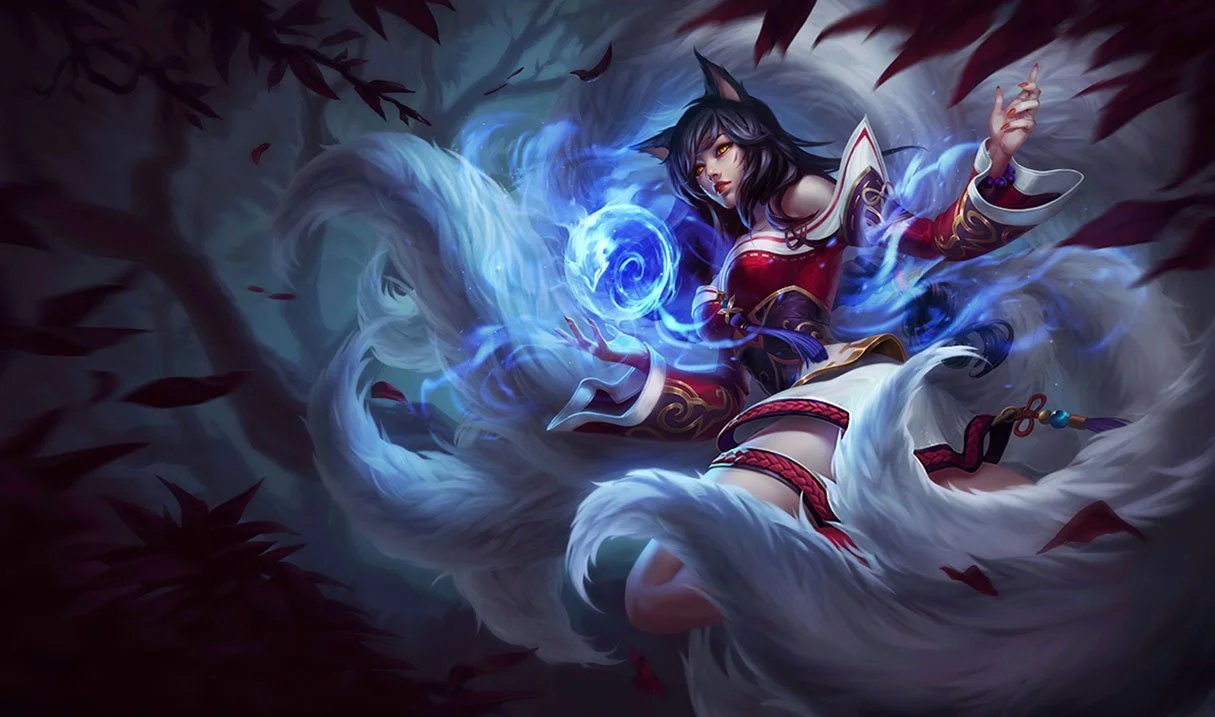
Classic Ahri splash art. Copyright (C) Riot Games
“Memories are no longer mine to steal, they’re mine to make.” - one of Ahri’s in-game long move quotes.
To understand Ionia’s unique interpretation of the real-world mythology of the nine-tailed fox, we first need to find out what the region treats as a “person”, and this is why Ahri is the perfect example of starting this cultural analysis.
Many fantasy settings, like League of Legends, inherit a familiar assumption: sentient, intelligent beings have an inner essence. A soul, an essence, consciousness. These words fundamentally mean the same, even if experiences accumulate. Change affects the individual, but it does not transform the “essence” of their existence. For example, one can interpret that even after thousands of years of (unintentionally) absorbing the life force of individuals she came into contact with, the Ahri of one thousand years ago is essentially the same as the Ahri of today.
However, Ionian storytelling challenges this concept, as identity appears more like an ongoing continuity that has to be maintained instead of a contained object that fundamentally does not change. A being only remains itself if the experiences can be integrated into a coherent whole, and if one thing or another deviates from this coherence, then that being is, in easier terms, “fundamentally changed."
French philosopher Paul Ricoeur describes this distinction as “narrative identity”: a self persists not because the “essence” inside it never changes, but because the memories it collects can still be told as one story instead of disjointed fragments that are incoherent. Therefore, continuity is not inherent but achieved through memory collection and (re)collection.
The same concept can be found on the other side of the world, as scholars of East Asian philosophy have actually explored this concept hundreds of years before Ricoeur. They described how personhood and the self are stabilized through remembered relationships and actions they did. Existence and identity are not just “substance” but rather a continuous process.
From this perspective, Ionia’s boundary (or lack thereof) between the physical and spiritual represents the concept of existence, forming a spectrum of participation rather than a rigid hierarchy of categories. This can even be applied to a real-world example: an Indonesian man who migrated to Germany at age nineteen and has been living there for ten years. While his passport and parents are Indonesian, he adopts the culture and experiences of that new country.
This is the condition that Ahri lives in. The existential dilemma that exists within her is not just that she harms others by “being herself," but also that she is losing parts of herself, one absorbed soul at a time.
Consuming Memory
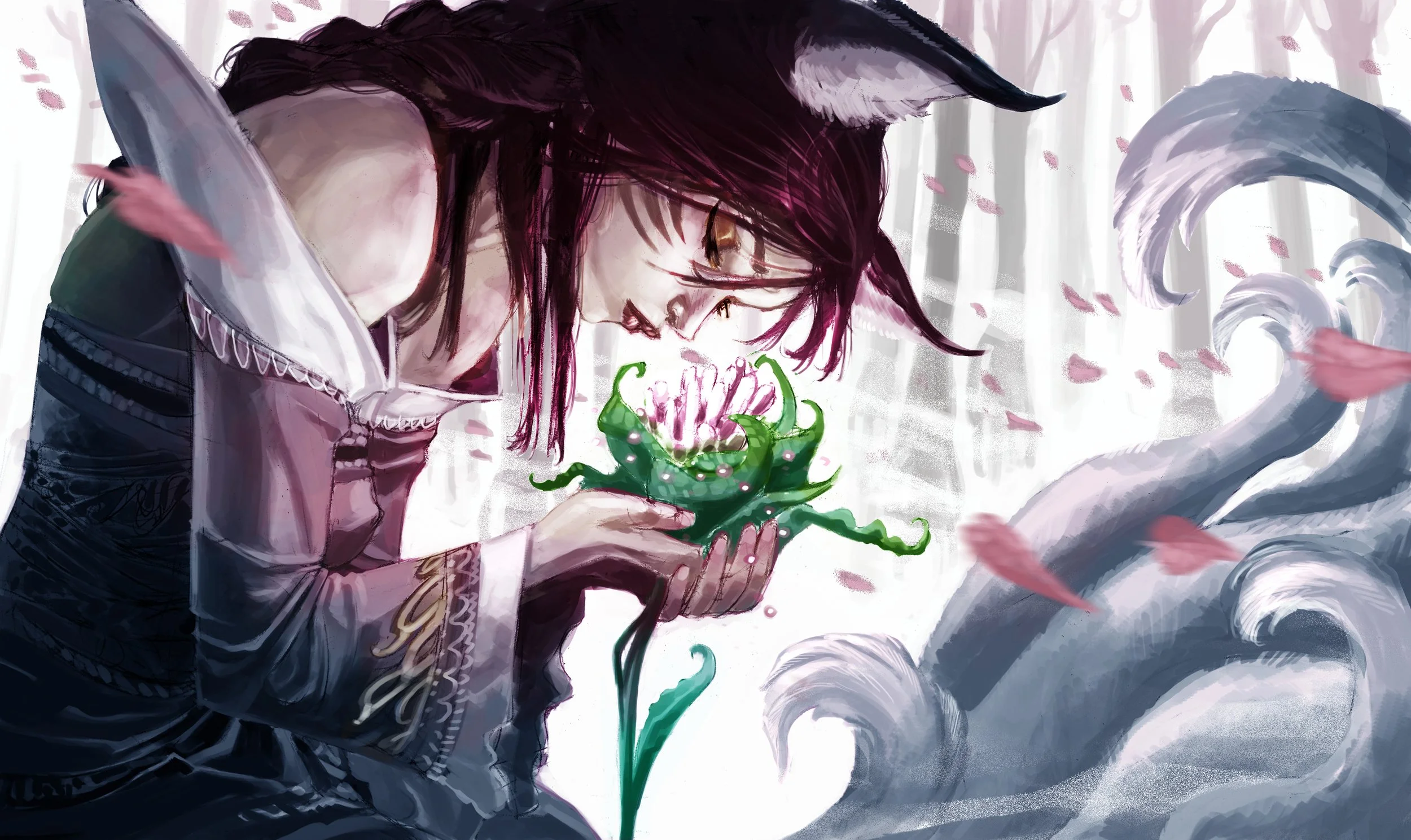
Key art for the color story, The Garden of Forgetting. Copyright (C) Riot Games.
“As dark vines and snow lilies began to overgrow and cover the exits out of the garden, Ahri managed to escape with her vastayan reflexes and decided that she would, from now on, live from her past pains and experiences rather than regret and attempt to forget them”. - Ahri’s introductory story, The Garden of Forgetting
As reflected in her passive ability, “Essence Theft”, Ahri’s signature ability can be described as feeding the life essence of other sentient creatures. When taken literally, she can be considered a being filled with predatory lust. However, the narrative falls somewhere completely different. As explained in her color story, Ahri eventually saw the memories of how humans perceive her - as a ruthless predatory monster, until one day, during a chance encounter with a painter, she finally bonded with someone who saw her as just “Ahri” and not the monster people made her out to be. The painter ultimately met his untimely end when Ahri lost control of her ravenous instincts, prompting her to finally want to get rid of the “curse” that had been plaguing her.
This “curse” essentially works like this: when Ahri absorbs someone’s memories, she does not merely learn information. She also experiences attachment, emotions, and relationships that do not originate from her own life; hence, she saw how humans perceive her. Each encounter or essence stolen introduces another fragment into her existence.
Within a consistent, stable model of identity, this would be traumatic but survivable as the individual only “gets” additional experience that does not change their identity. However, in a continuity-based existence like Ahri’s, the distinction between “my experience” and “someone else’s experience” is what allows her to be singular at all. Philosophers sometimes illustrate this with the metaphysical concept of the Ship of Theseus: if we replace each part of a ship with new ones, is it still the same ship? In the case of Ahri, it is the inverse, since nothing physical about Ahri inherently changes, but parts of her lived past do not exclusively belong to her.
Therefore, Ahri suffers from a unique condition that destabilizes her existence; submitting to her tendencies means losing parts of “herself”. By consuming the essence of other creatures, she risks becoming plural and no longer just “Ahri”, which is why the act of self-preservation not only prevents her from ending the lives of other people, but also losing her own identity.
The search for her lost Vesani tribe was also a catalyst for the search for an identity that she can relate to. Like the “Indonesian man moving to Germany” example in the first part, what Ahri sought was a group of people who looked like her, but without the traumatic experiences she had to endure. Here, it was not a simple satiation of her own curiosity, but rather an anchor to which she could attach herself. In this case, Ahri was not trying to become human, but rather become singular.
What Ahri Reveals about Ionia

Photo from Pixabay.
“She felt their lives linger inside her.” - taken from the color story, A Fair Trade
When read in isolation, Ahri can be depicted as a tragic individual whose instinct is to harm others and must learn how to control her tendencies. However, when read through the lens of Ionia’s storytelling and worldbuilding, it describes something completely different: the possibility of a self that may lose its coherence.
Many of Ionia’s conflicts involve narratives that deal with imbalance, but imbalance rarely means simple disorder. Here, the word means a breakdown in continuity and the disruption of the status quo. For example, war disrupts generational memory, and long-lasting institutions act without intuition. In the case of Ahri, she embodies this in the “personhood” level. As an essence-consuming creature, she lives in a state where experience accumulates faster than identity can integrate it. Every time she consumes the spirit of others, she gains increased understanding while losing her own individuality.
Like other cases that we will be discussing down the line, Ionian stories often treat restraint as protection rather than passivity. By limiting action, the region depicts protection as the preservation of coherence, not only of the self, but also of relationships, the environment, and the realm of spiritual existence. Any form of imbalance, such as excess, is treated as a threat that can dissolve these distinctions, even when motivated by good intentions.
Therefore, Ahri occupies a role that can be considered paradoxical. She is both empathetic yet dangerous, connected yet isolated. The tragedies that befall her is not through the absence of her humanity, but that she cannot keep a stable enough distance with the people she comes into contact with. In this case, instead of struggling to understand others, she risks understanding them too completely and let the lived past of others essentially become an integral part of her existence.
Ionian culture is one where identity depends on continuity. Death here is not the end-all-be-all, but rather the dispersal of one’s identity and the erasing of one’s existence from the annals of its culture and history. Ahri’s existence is not only Ionia’s most vulnerable expression, but also a frightening case of how the dispersion of identity affects not only the “self”, but also the world around it.
The tragedy of Ahri’s existence is that she cannot become too close with others without slowly losing her own identity. This can similarly be applied to the region of Ionia itself; sometimes survival demands change, and change threatens recognition. Some will preserve it, others will carry it forward, and both believe they are protecting the same world.
Further reading
Paul Ricoeur - Oneself as Another
Roger T. Ames - Confucian Role Ethics
Jan Assmann - Cultural Memory and Early Civilization
The Ship of Theseus (classical metaphysical thought experiment)
Reading Runeterra was created under Riot Games' "Legal Jibber Jabber" policy using assets owned by Riot Games. Riot Games does not endorse or sponsor this project.