
Neeko and the Pursuit of Love and Belonging
Who is Neeko?
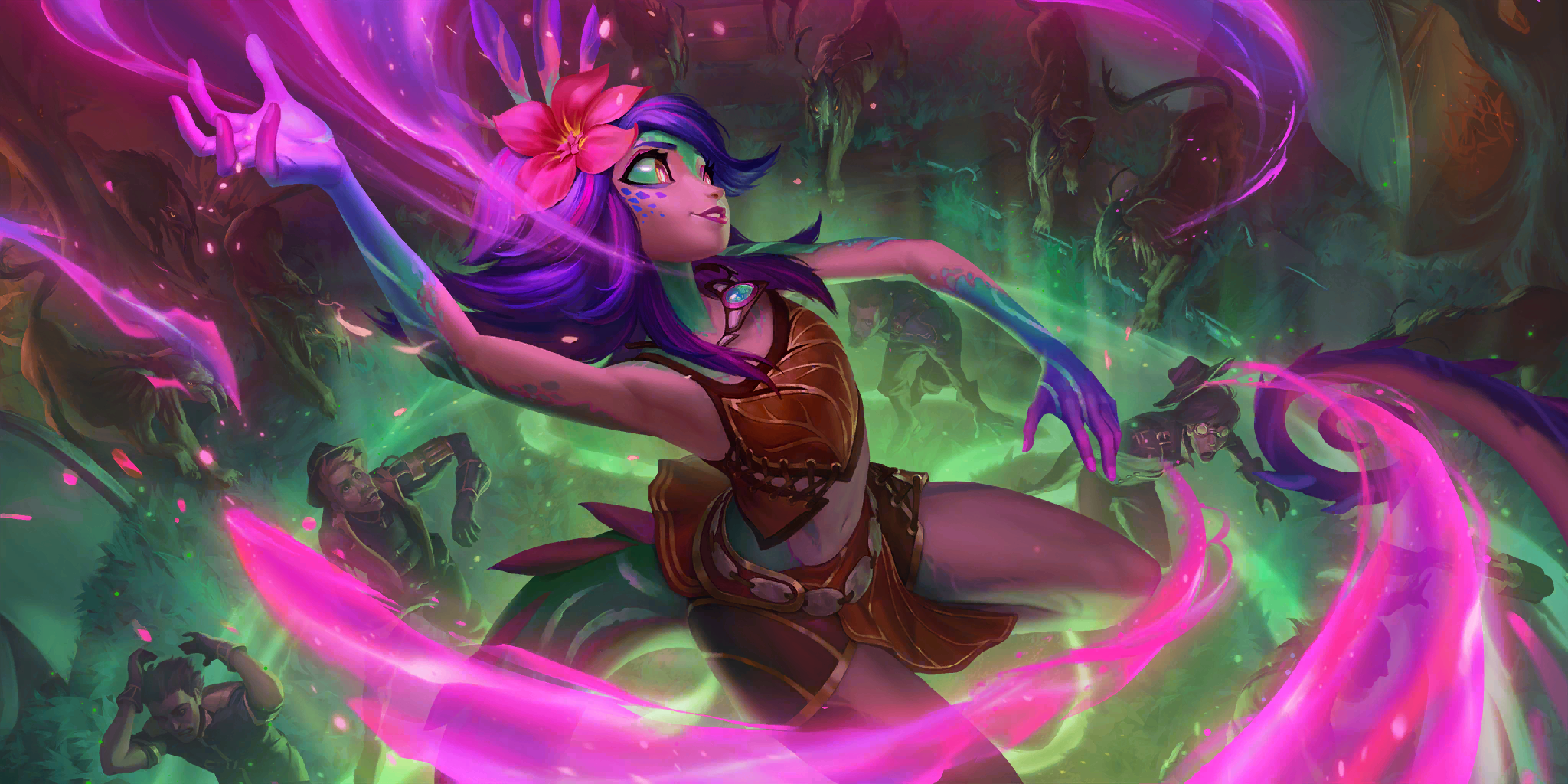
Neeko (presumably) using Pop Blossom. Copyright Riot Games.
"You are Vastaya! Neeko is Oovi-Kat. We are... cousins? Distant cousins!" - Neeko’s voice line when encountering a vastaya.
The diversity of the vastaya in the lore of League of Legends is such a fascinating read, especially in terms of how they relate to themes in the field of cultural studies. From the personhood dilemma of Ahri to the hybrid relationality of Sett, the vastaya provides many angles from which they can be analyzed, and this next one is no different.
Meet Neeko, also known as the Curious Chameleon. She is an Oovi-Kat vastaya, which are more chameleonic or lizard-like in form. However, unlike other vastaya species, the Oovi-Kat retained most of the traits of their ancestors known as the vastayashai’rei, which are considered the ancestors of the vastaya. A key trait that Neeko and others of her kind inherited is the ability to shapeshift into other creatures, such as humans, animals, or even other vastaya, with the only prerequisite for this transformation being the presence of a sho'ma, which basically equals to the soul in the real world. In this tribe, Neeko grew up to become someone who was inquisitive and curious about everything in this world.
However, one day, a cataclysm eliminated the Oovi-Kat tribe and Neeko was left as the sole survivor, and after days of lying adrift in the ocean, she was finally landbound. But, from that point onwards, she was alone. Not just alone in the sense of being the only person abroad, but also in the sense that she was the last survivor of the Oovi-Kat. Her surviving the cataclysm brought upon a form of collective trauma, but the main issue is that she does not share the same lived experience as anyone else, as they have all been eliminated by the cataclysm. To put it simply, Neeko cannot process the grief of losing her tribe as an Oovi-Kat, because there is no other Oovi-Kat to share her grief with.
Thankfully for Neeko, she would not have to process her grief alone anymore. While the Oovi-Kat remained extinct, she would encounter Nidalee in the jungles of Ixtal after shapeshifting into a cougar-like creature in an attempt to blend in, and after an intense standoff between the two, Nidalee would take Neeko in as one of her own.
Encountering Nidalee was the best outcome for Neeko after the cataclysm of her people, and after a while, the two would develop a companionship that reflected the openness and curiosity of the Oovi-Kat tribe. Despite their blossoming relationship, however, Nidalee elected not to join Neeko in her adventures to explore the world, and once again, the curious chameleon was left alone, taking on the sole burden of the Oovi-Kat’s legacy again. But alas, Neeko was steadfast in her goal of a magical future where she can befriend anyone with a sho'ma.
Shapeshifting and Camouflage
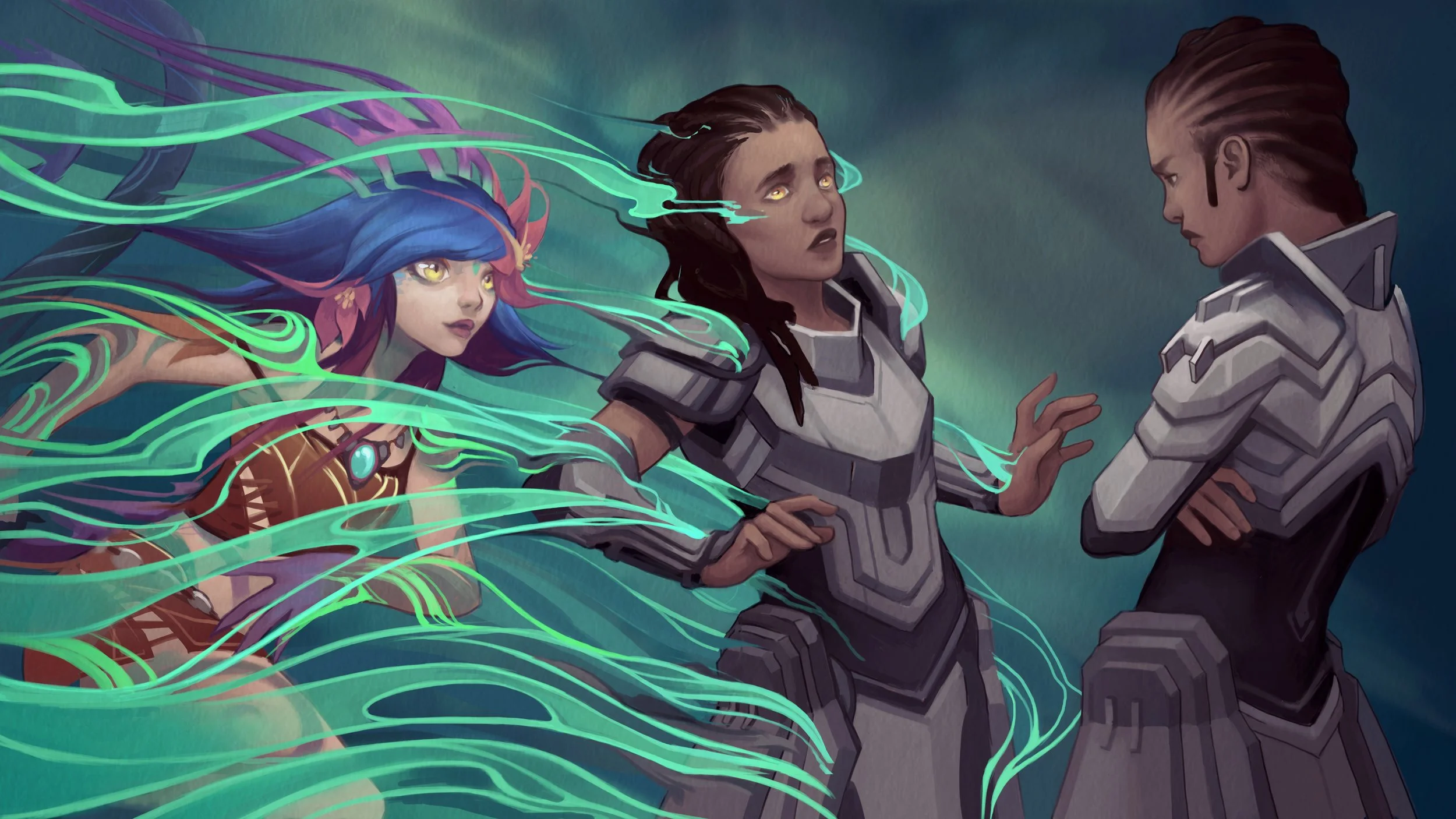
Neeko trying to camouflage as Noxian soldiers in The Monster of Kalduga Post. Copyright Riot Games.
"I want to become everybody! Who says I cannot? I will prove them wrong! Then, I will become them. Last laugh? Neeko!" - one of Neeko’s first move quotes.
Neeko’s most interesting ability is her passive, aptly named Inherent Glamor. From a lore perspective, Neeko can transform into other creatures by understanding their sho'ma, which is then reflected in-game by her being able to transform into any ally unit (ally champions and minions). In-game, this is utilized to deceive opponents both offensively and defensively, integrating well with her other abilities, with her R, Pop Blossom, being the one benefitting the most from this integration as she can cast the ability while taking the form of a minion.
When looking at the ability from a philosophical perspective, however, things become more interesting. The Oovi-Kat tribe originally thrived by understanding other creatures by transforming into them. Here, Neeko transforms to get a perspective of the lives of others, which works really well with her title. According to sociologist Erving Goffman, all social interaction can be read as performance and we play different roles to different people. In the case of Neeko, she interprets this literally and takes on the roles to their entirety, or simply said, while we humans put on a mask based on their role, Neeko becomes them entirely. However, the concern here is that what becomes of Neeko without the transformations? Does she live solely through the lens of others? According to Goffman, a person can always retreat to the backstage and live their true selves there. However, in Neeko’s case, that backstage does not exist, since does not have a so-called private face in a way that she lives completely true to herself.
By transforming into other creatures, Neeko essentially takes on their physiology and anatomy, but not their lived experiences, which is why the in-game implementation only allows her to copy the form and basic attack animations of allied units and not the entire champion kit (unlike champions like Viego (who takes over entire champions after killing them) or Sylas (who steals enemy ultimates)). One can interpret this as the limitations of the Oovi-Kat’s (or at least Neeko’s) powers when it comes to camouflage, but in reality it might just be for balancing, otherwise she would be broken beyond belief. What is actually possible to interpret is the reason for the transformations. Based on Bhabha’s concept of imitation and mimicry, one can deduce that Neeko’s purpose for transformation is a subversion of this concept. Where others use mimicry to adapt and survive in a power structure (in real life, this could be adopting certain cultural habits), Neeko uses this to understand others and feel less alone. It is a visualization of empathy in which she relates to other creatures by literally ‘putting herself in their shoes’.
Another perspective that can be taken is through Neeko’s queer identity. Her writer, Matt Dunn, confirmed that she was a lesbian and therefore the first champion confirmed to be part of the LGBTQ+ community. Her camouflaging ability can be interpreted as an analogy of how queer people hide their queerness from the general public, since being out in public is still seen as taboo in certain areas and illegal in some. In Runeterra, however, since the concept of coming out does not exist and different sexual orientations are relatively normalized, the purpose of Neeko’s camouflage is to understand others on how they would accept her as a whole rather than a straightforward acceptance of her queer identity and sexuality.
Neeko’s queer utopia
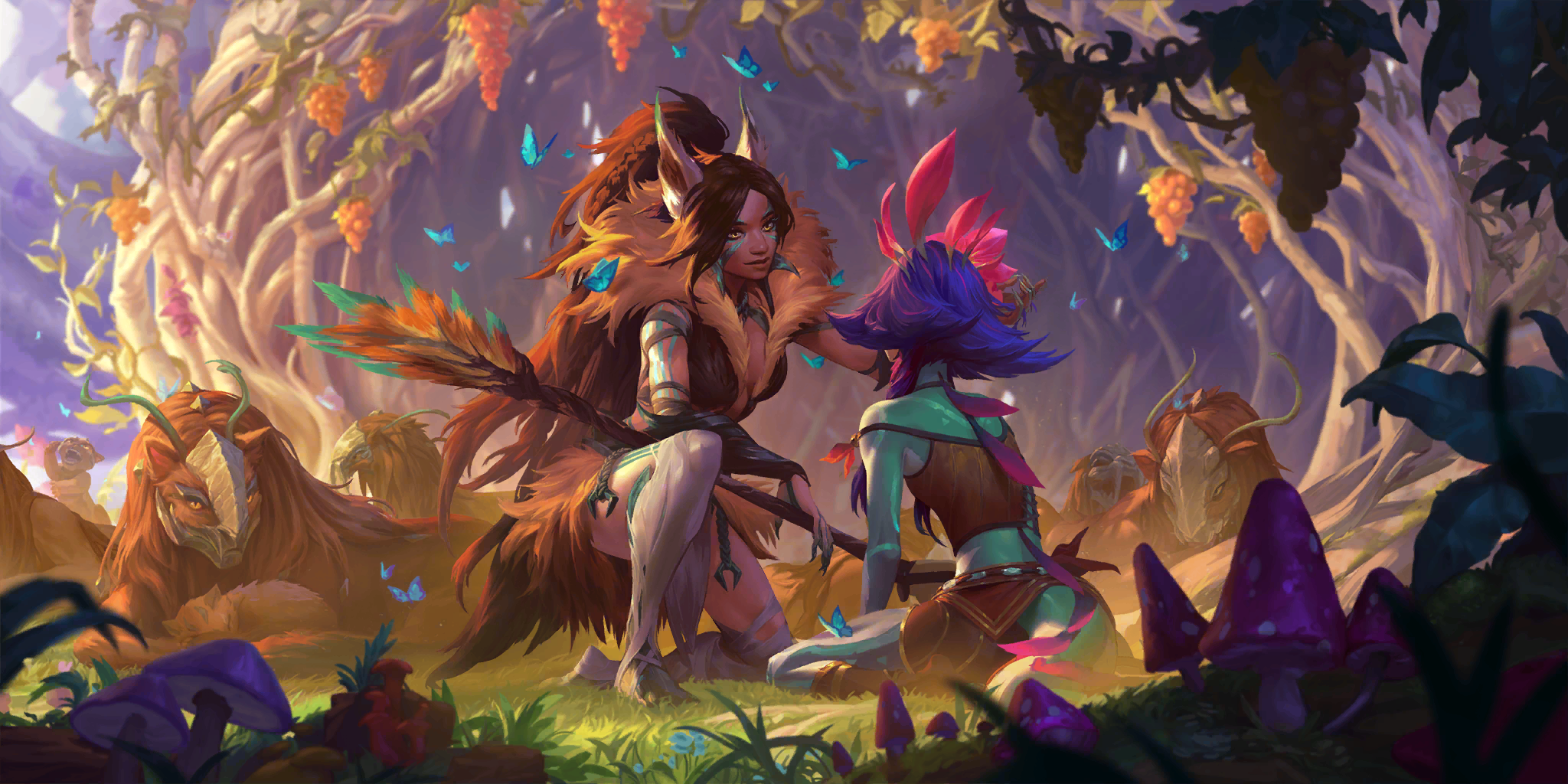
Neeko reacquainting with Nidalee. Copyright Riot Games.
"To know Neeko is to love Neeko, and to love Neeko is to be Neeko." - the last line of Neeko’s biography story, The Curious Chameleon.
In her biographical lore, Neeko vows to create a tribe where like-hearted beings, be it vastaya, yordles, or humans, can coexist and be friends with each other, and as far as she is concerned, everyone can be part of that tribe. In this case, she is not reconstructing the Oovi-Kat tribe in its entirety, but rather a tribe that represents Oovi-Kat values while including everyone that wants to be in it, irrespective of their species or origin. The memory of her extinct tribe is just a blueprint for Neeko to continue not only her own hopes and dreams, but also those of her predecessors who perished.
At first glance, one can read Neeko’s goals and dreams as something utopian, especially considering the tribe is built on love, joy, and happiness. However, there is a certain impossibility in creating this tribe, especially in the context of a chaotic world like Runeterra where idealistic scenarios very rarely come into fruition, and Neeko’s is no exception. The first factor is, ironically, Neeko herself. The Oovi-Kat lived in a tribe of transparency and openness with their sho’ma visible to others, yet since they no longer exist, the only one who lives like this is Neeko, and others who join the tribe will not have this ability to detect the sho’ma of others or be as transparent. As such, what might first be seen as utopian, can have dystopian characteristics in which the ‘ideal’ tribe might not seem that ideal after all. When thinking about Neeko, yes, she might have the ability to transform into other creatures, but where does that leave the true nature of her own sho’ma?
An interesting read here is José Munoz’s Cruising Utopia. There, he introduces the concept of queerness as utopia. One interpretation of this concept is that being queer is something out of reach, or at least always in the distance and not in the here and now. This concept depicts Neeko’s utopian tribe to a tee, as her dream revolves around being transparent and loving each other regardless of species. While not explicitly stated, Neeko is probably the champion that represents queer existence the best, not just due to her own queer identity, but also due to how she represents the concept of queerness as utopia, even though after her release, there have been many champions who have been released as being queer (e.g., K’Sante and Rell) or having their lores retconned to make them part of the LGBTQ+ community (e.g., Nami and Graves).
In any case, Neeko’s lore and identity can be interpreted as an allegory to queer existence and what utopian existence means in a queer sense. While her dream tribe might be a stretch to realize, especially considering how Runeterra works as a world, the fact that she hopes to create a community where everyone can not only be themselves, but also understand the heart of others is a truly admirable cause, even though the journey might be arduous.
Further reading
Homi Bhabha - Of Mimicry and Man: The Ambivalence of Colonial Discourse
Erving Goffman - The Presentation of Self in Everyday Life
Jose Munoz - Cruising Utopia
Sara Ahmed - Queer Phenomenology