
Unleashed Power: Syndra and Breaking Suppression
Interpretations of Syndra’s Power Suppression
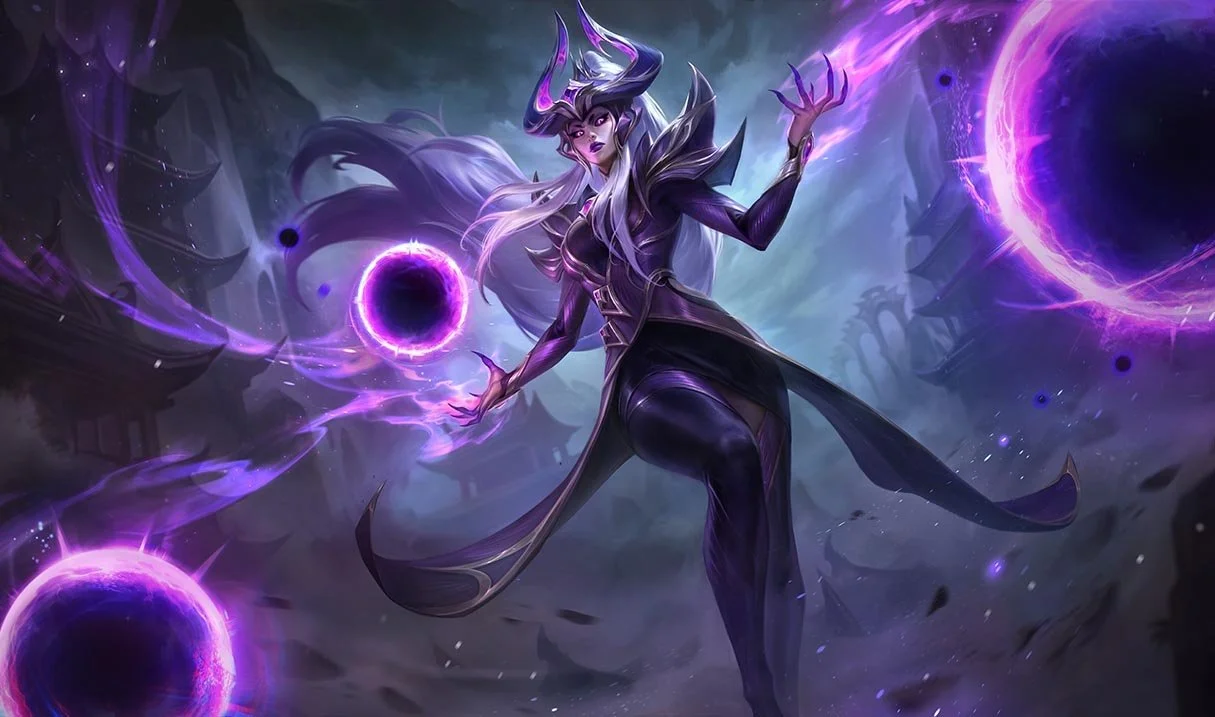
Classic Syndra splash art. Copyright Riot Games.
“People fear what they cannot understand” - one of Syndra’s movement quotes
Like most traditional ‘villains’, Syndra’s story begins with personal trauma. As a child, she was relentlessly bullied by her older brother, Evard, for being easily distracted and thought to bring ‘misfortune’ to the family, and after an incident where one of Evard’s bully friends threw mud at Syndra, her innate magical powers awoken and subsequently destroyed the ghost-willow, a tree considered sacred to her tribe, which ultimately led to the family’s exile. Noticing the growth of her powers, Syndra was then sent to tutelage under Konigen, a hermit-priest, where she could hone her magical abilities. However, this proved to be a mistake as she noticed the gradual waning of her powers since he had been locking himself away due to her ever-strengthening magical abilities. Ultimately, Syndra killed him in a fit of rage and in a last-resort attempt, the Spirit of Ionia intervened and sealed her inside a magical pool for hundreds of years.
We can interpret Syndra’s story from multiple lenses, and a fascinating one is through a feminist or emancipatory one. Her story is an allegory of how powerful women, both in a literal and figurative sense, tend to be suppressed and vilified. In the case of Syndra, she ended up being both, with her being sealed away for centuries as the Spirit of Ionia perceived her to be a force that can bring imbalance to both the material and spiritual realm as well as in her young age, her having powers meant she was considered ‘different’, especially compared to her older brother and his friends, which meant she was vulnerable to bullying and vilification. Also, during her tutelage with Konigen, she ultimately broke away from the metaphorical chains that bound her powers, which can be colloquially aligned with, for example, someone who leaves an oppressive partner.
Another perspective that we can take in analyzing Syndra’s story is the parallels her story has with the Salem Witch Trials in the 17th century. Religious authorities regularly used to prosecute women who did not adhere to the ‘code of conduct’ of the majority religion and perceive women who stand up for themselves to be a threat. Syndra’s story revolves around the same concept, but this time she actually has powers that can eliminate one’s life if they end up setting her off, putting herself on a power level significantly above her supposed oppressors.
Syndra and Feminine Wrath
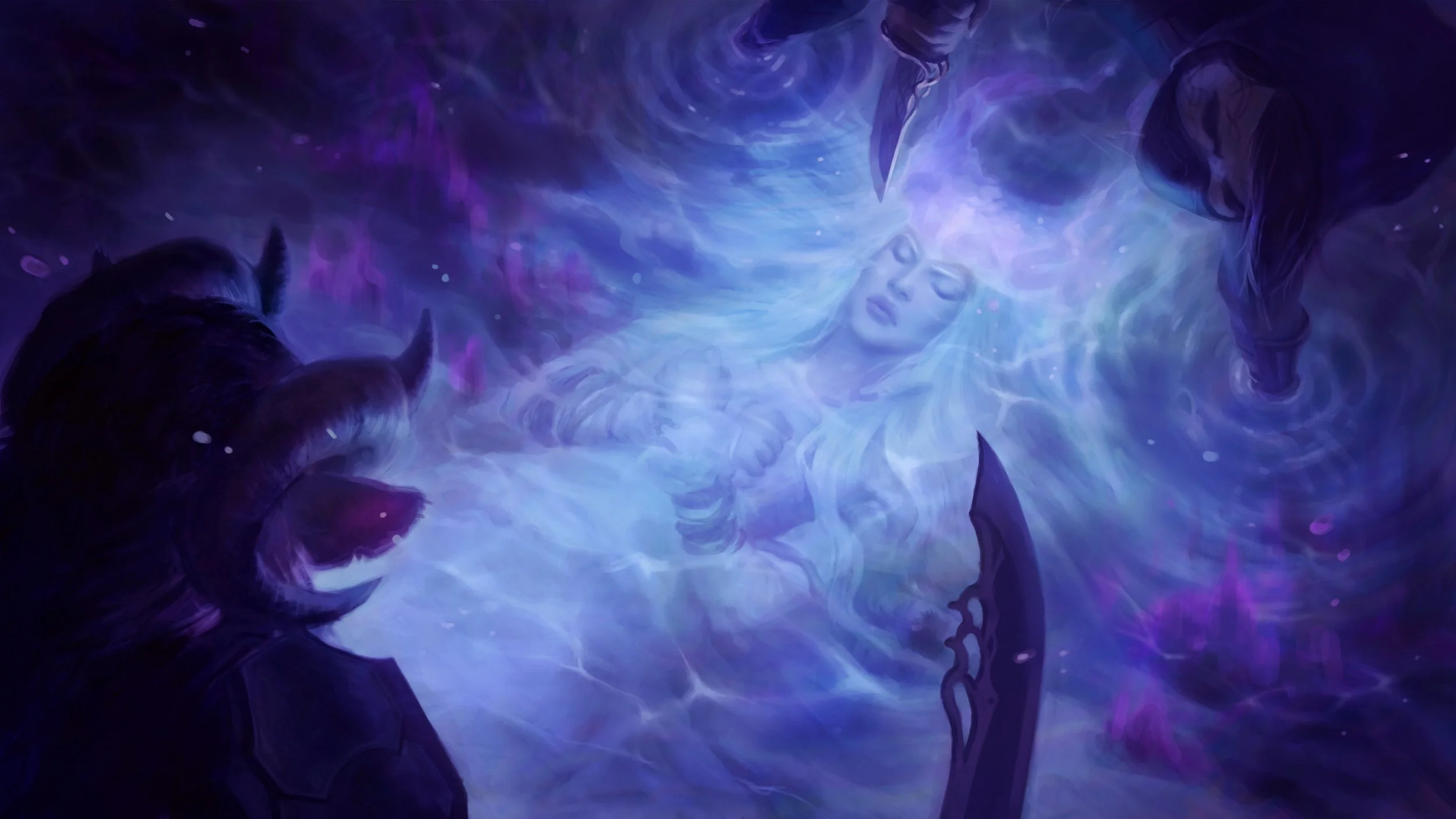
The Dreaming Pool. Copyright Riot Games.
“Imprisoned no longer”. - one of Syndra’s attacking quotes.
Syndra’s biography revolves around being initially forced to suppress her innate magical abilities, but then, through anger and wanting to break the chains that bound her, her powers manifested into something destructive that put the Ionian material realm into imbalance, thus the imprisonment in an eternal state of stasis in something called the ‘Dreaming Pool’.
The suppression of her powers can be interpreted as an allegory of the suppression of powerful women in an anti-feminist context, and her ultimate ‘breaking of the chains’ moment is the unleashing of the innate anger that came after years of oppression and suffering. This can be explained through the ideas of Audre Lorde, who explained that every woman has a well-stocked arsenal of anger potentially useful against those oppressions, personal or institutional, which brought the anger into being. This lines up perfectly with Syndra’s story of power suppression and eventual murderous streak through unleashed anger, as she had lived a life that suppressed not only her powers, but also as a human being. The constant harassment from her brother and his friends during childhood, the exile after the ghost-willow incident, and eventually the betrayal of trust from her mentor led to her ultimate unleashing of this wrath that was inside her this entire time.
Here, we also refer to the concept of the epistemic value of feminine (or feminist) anger. Even though gender roles in Ionia are more fluid than in the real world, such as how Akali’s name follows a matrilineal structure (taking the Jhomen Tethi name from her mother), there is still this expectation for women to suppress their emotions, with anger being seen as a more ‘masculine’ characteristic and expected within male-dominated spaces in Ionia. Syndra, however, subverts this expectation in which she reacts to her significant conflicts. Instead of internalizing her anger (which is how feminine energy is traditionally interpreted in culture), she externalizes it through unleashing her powers. When she has her bouts of rage, she is not losing herself; she responds to a genuine violation of her value as a person, a woman, or an Ionian.
However, with Syndra’s power and propensity for uncontrollable anger being an established threat to balance in Ionia, her emotions were never considered as a legitimate concern of the institutional discrimination and ‘misogyny’ present in Ionian society. Expressing anger puts oneself in the position of the ‘judge’, which a woman, even in a traditionally progressive society like Ionia, is considered insubordinate. The suppression of her powers by external parties, be it through her former mentor or her family, as well as the traumatic events that ultimately built up the anger and rage within her, such as the ghost-willow incident and her family’s subsequent exile, must be, in a way, be given an outlet, and unfortunately, rage was the and anger were the manifestations of said power, hence her in-game skills having negative etymological connotations, such as Dark Sphere and Scatter the Weak.
How powerful is Syndra exactly?
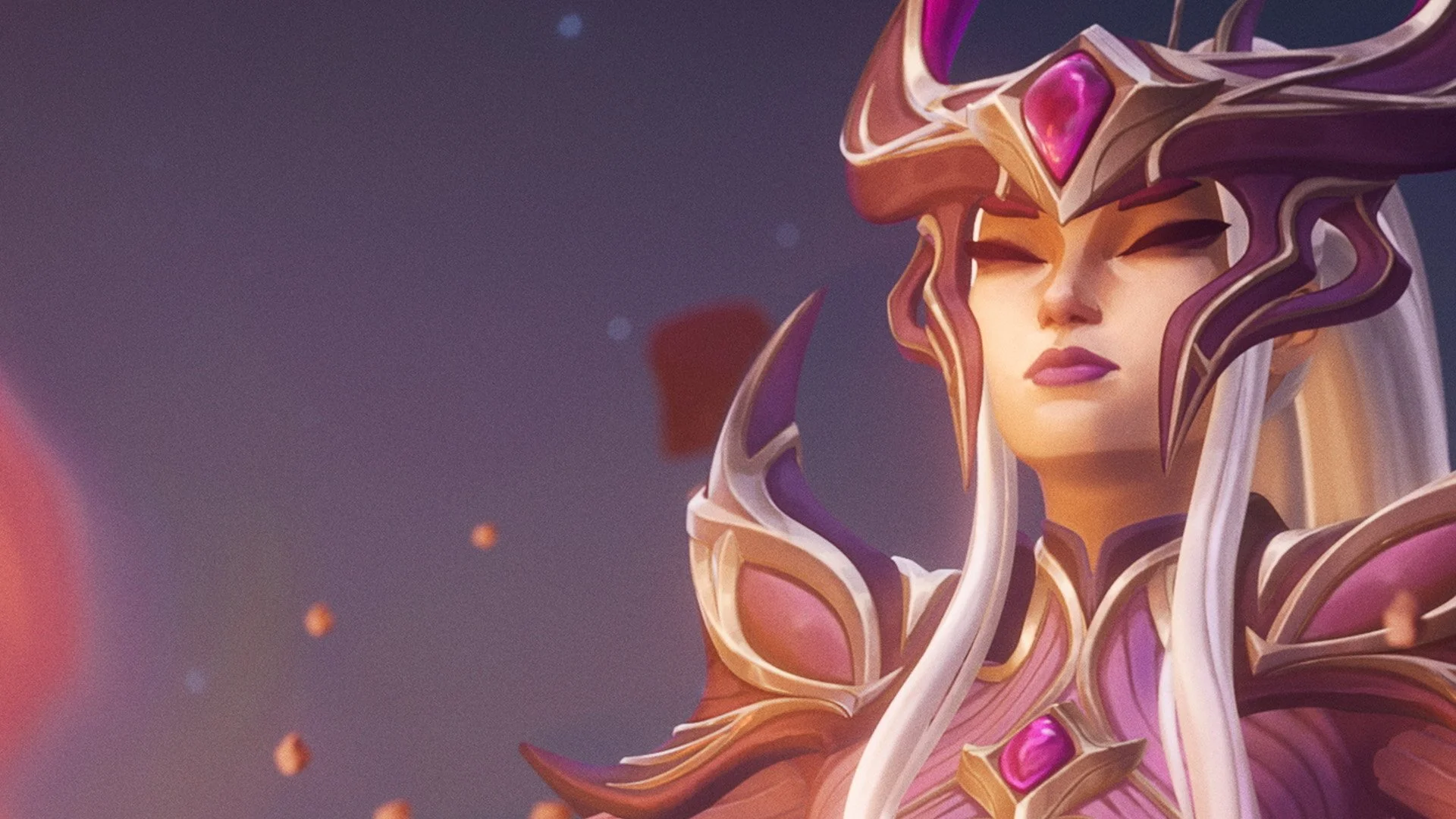
Depiction of Syndra in Rise of the Dark. Copyright Riot Games.
“I am in control”. - one of Syndra’s movement quotes.
Despite her immense powers, Syndra is a character that feels one-dimensional and isolated within the context of Ionian existence. She has very little interaction with other Ionian champions, which is why it feels like she is powerful or evil in a vacuum. Comparing this with another villain-type character like Jhin (who essentially caused chaos for prominent champions like Zed, Shen, Akali, and Camille), Syndra does not feel like a proper villain or a threat for other characters, even though power-wise, Syndra’s magic infinitely trumps Jhin’s capabilities with guns and other contraptions. In a way, how powerful she actually is can only be contextualized if she comes into interaction with other champions, especially ones with similar power levels, such as Karma or Ahri if we are specifically speaking in an Ionian context.
Here, we can refer to Hannah Arendt’s differentiation between power and pure force. She said that power requires recognition and or an opposing force to quantify the scale of said power. Like explained above, Syndra’s is not contextualized, and as such, we cannot understand the extent of her abilities. To put it simply, we can refer to Ahri as a baseline for comparison. Syndra kills by unleashing her powers, whereas Ahri unintentionally does it. Does that mean Syndra is more powerful than Ahri simply because she has an agency on who she kills? Or is it the opposite where Ahri is stronger because she does not need to put any effort into killing another creature? The thing is, we have seen Ahri’s powers quantified in other narrative depictions, such as in the video game, The Ruined King, where she can be compared with other champions such as Pyke, Illaoi, and Braum, whereas Syndra has not.
When thinking about power, what Syndra has been pursuing this entire time is complete freedom from those who try to ‘shackle’ her. However, this concept does not exist, neither in the real world nor in fictional ones like the world of League of Legends. Complete freedom has no context and is destructive, and without an anchor, it just becomes a void in which that strength or power of the beholder becomes another prison, and we have established earlier in the text that Syndra does not want to be shackled by an external party.
So, where does this leave Syndra narratively? One way to make her more multidimensional is to give another (preferably existing) champion to contextualize said powers. Being known as ‘the Dark Sovereign’ as a default title, what Riot Games can eventually do is to bring meaning to that ‘sovereignty’. Maybe folklore of Syndra has been told to, for example, the likes of Irelia and the Kinkou Order, but since there has not been any official lore regarding this, Syndra still feels isolated from the entirety of Ionia. Ironically, her lore that came with her launch back in 2012 had more relations to other characters, such as the aforementioned Irelia and Karma as well as Annie and Veigar. Interestingly enough, all of the four mentioned champions have been utilized in the mid-lane against Syndra in competitive League of Legends.
Ultimately, Syndra’s tragedy is ultimately one of excess. She has too much power yet also too much pain. However, what she still had was agency over her powers. Unfortunately, some characters who were burdened with immense powers did not have that same agency, and were left sealed for thousands of years. That is, until one day two lovers heard voices from a sealed temple in Ionia and encountered a weapon of mass retribution.
Further reading
Shiloh Whitney - Anger Gaslighting and Affective Justice
Audre Lorde - Anger and the Power it Holds
Frantz Fanon - Black Skin, White Masks
Riot Games - The Dreaming Pool
Reading Runeterra was created under Riot Games' "Legal Jibber Jabber" policy using assets owned by Riot Games. Riot Games does not endorse or sponsor this project.