
The Fourth Act: Jhin and the Aestheticization of Violence
The ‘Perfect’ Number
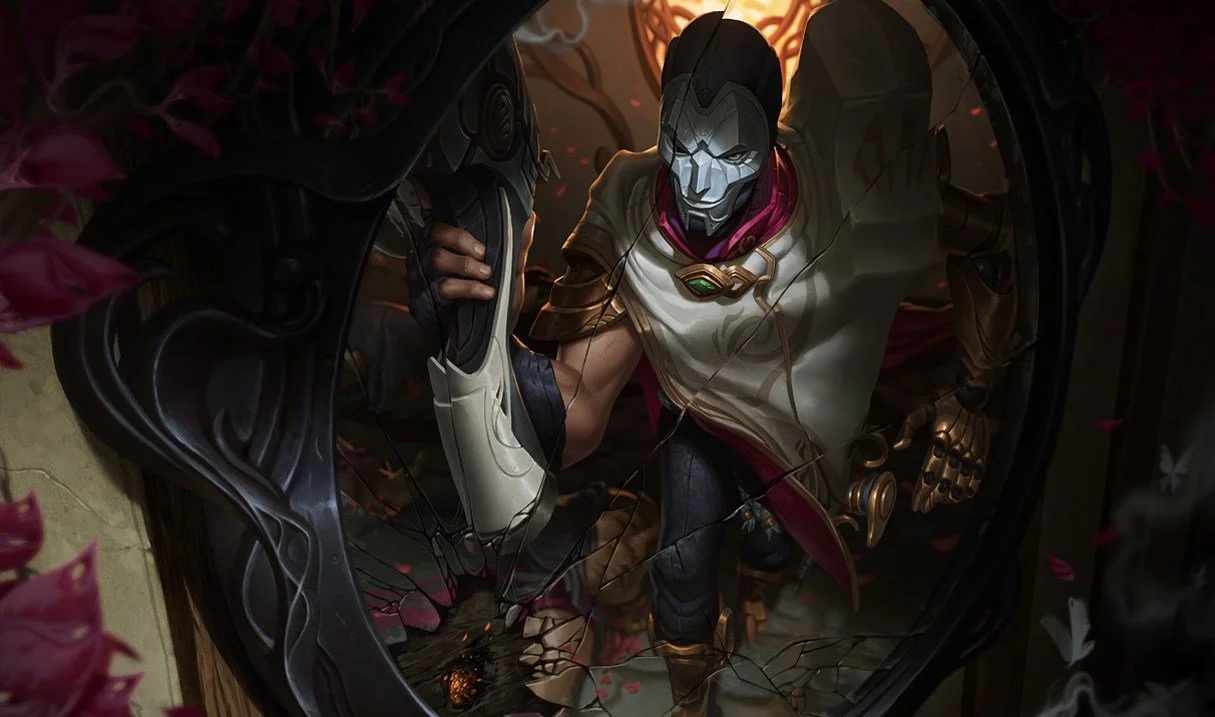
Jhin original splash. Copyright Riot Games.
“In carnage, I bloom. Like a flower in the dawn” - Jhin’s champion selection quote
Understanding Jhin means understanding his obsession with the number ‘four’. But, how does his thematic motif relate to the number? In League of Legends, his kit revolves around having the following: he can only fire four auto attacks before reloading, his Q skill, Dancing Grenade, bounces four times, his W, Deadly Flourish, will root the target if triggered within four seconds, his E, Captive Audience, reveals the enemy who triggers the trap for four seconds, and his ultimate skill, Curtain Call, can be fired up to four times, with the last one dealing the most damage. Outside of in-game mechanics, his name also has four letters (and on a normal QWERTY keyboard, one can make a ‘4’ with ‘JHIN’) and his champion theme song is played on 4/4. So, with all these in mind, why the number four?
In East Asian cultures, especially in China, ‘4’ is considered an unlucky number due to its relations with the word for ‘death’. The prevalence of tetraphobia in these cultures are also present in completely unrelated fields, like construction (buildings going from the 3rd to 5th floors are quite common) or telecommunication (Chinese phone numbers tend not to have the number). However, in the case of Jhin, it can be interpreted as an act of transgression against collective superstition. Instead of fearing the number, Jhin’s obsession with the number means embracing what (East Asian) society deems as taboo.
However, the number is not merely prevalent in East Asian culture. Greek philosopher and polymath Pythagoras originated the concept of the tetrad, which essentially represents the complete manifestation of reality as well as the ‘most complete number’. This is represented once again in Jhin’s kit as his fourth auto attack does the most damage and so does the final shot of Curtain Call. He considers the fourth shot to be the ‘beautiful end’ for his targets and emphasizes the significance of it being the ‘curtain call’.
Another perspective where we can explore Jhin’s obsession is through the concept of the ‘Jungian shadow’. His transfiguration with the number stems from him not integrating it into his own identity and thus created a persona that is not only obsessed with the number, but also the aestheticization of ‘the-four-act-violence’. His streak of violence in his early twenties, which was mostly due to him not having that good of a childhood, led him to becoming one of the most notorious killers in all of Ionia.
The Art of Violence
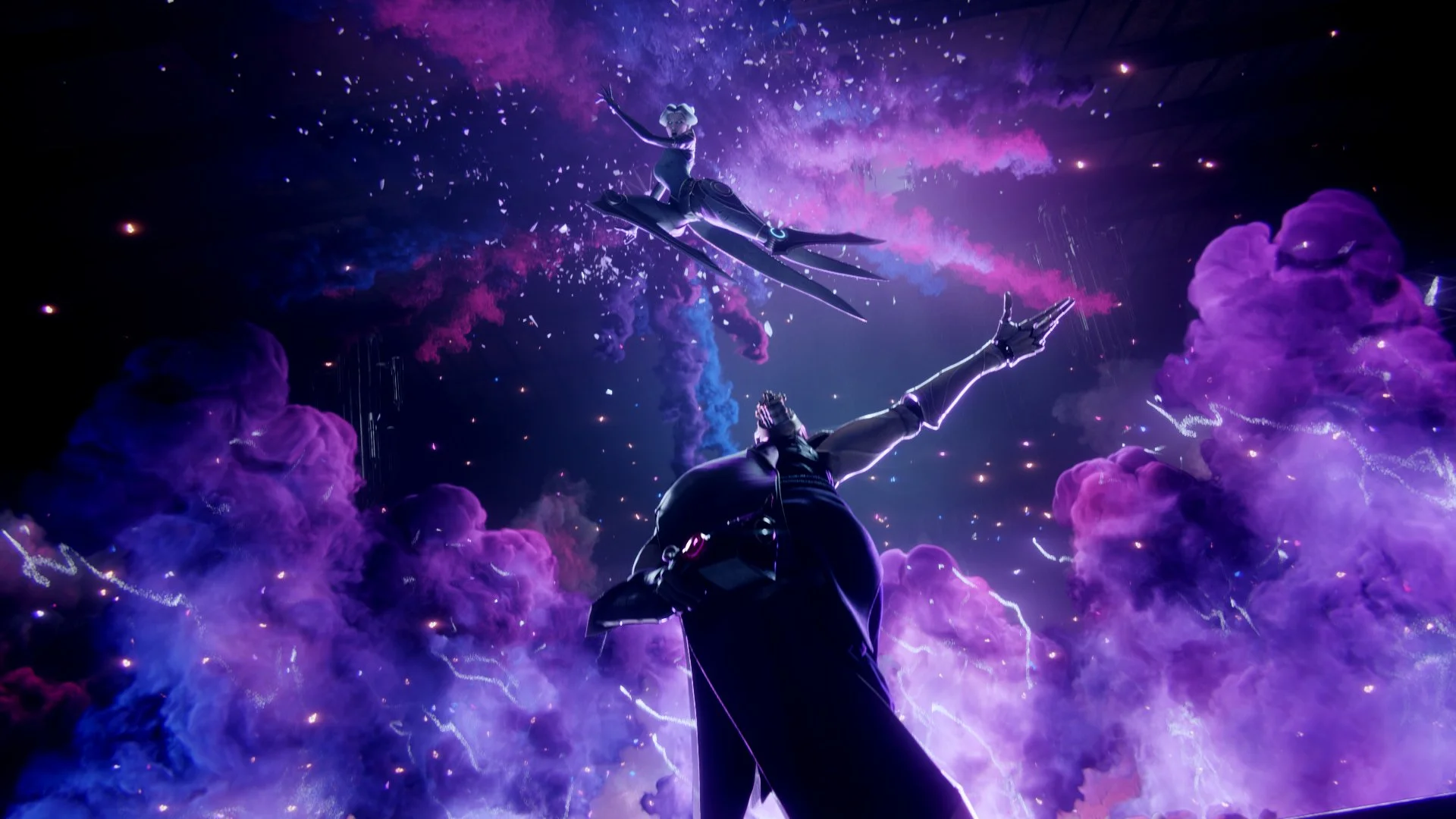
Jhin vs. Camille in the music video Awaken (2019). Copyright Riot Games.
“I live for the applause, you will die for it”. - one of Jhin’s attacking quotes.
For this part, we can draw upon the concept of the aestheticization of politics by German philosopher and critic Walter Benjamin. He posited that politics can be aestheticized through certain aspects such as rallies, choreography, and symbols, most of which contributed to the rise of fascism in Europe. We can apply this concept to Jhin as the ‘aestheticization of violence’ in a way that Jhin’s murders are the purest expression of making an epic performance out of acts of abhorrence.
This can also be applied to the experience of playing Jhin in League of Legends. Landing the final shot of Curtain Call that ultimately kills the opponent, hitting a long-range Deadly Flourish shot, or even firing a crucial fourth auto-attack are rewarding experiences for Jhin players as they immerse themselves in the mind of the Virtuoso himself. However, instead of making it a political spectacle, the murderous nature of Jhin can be described as ‘artistic sociopathy’.
However, another perspective we can take is through the audience. This time, we refer to Sontag’s Regarding the Pain of Others. There, Sontag refers to the ethical dilemma of watching atrocities and how the audience is also complicit in those acts, simply because they didn’t do anything about it. Regarding Jhin, he understands that audiences are already primed by their culture to receive violence aesthetically, which is why when we receive news about atrocities, in addition to fear, we are also fascinated about what happened. In this case, Jhin takes advantage of the fascination of the human mind and turns his killings into an artistic spectacle.
This is continued in the concept of ‘art for arts sake’ (fr: l’art pour l’art). The Aesthetic movement asserted that there was no inherent connection between art and morality, and thus the following sentence can encompass the concept: if it is beautiful then how we get there or what it brings to the people is irrelevant. Aesthetics believe that art ‘only needs to be beautiful’ and in many ways, Jhin represents the darkest fulfillment of this concept. However, instead of applying this to poetry or artistic performance, he applies this to killing people.
Finally, the aestheticization of violence can be immersed in the experience of playing Jhin in-game. His presence and voice lines essentially break the fourth wall, positioning the player as the architect of Jhin’s artistic murders. His design, beautiful animations (especially for a champion released in 2016), and voice lines represent the concepts above so perfectly. As someone who has been playing the game for thirteen years, the satisfaction of hitting the final Curtain Call shot or a long-range Deadly Flourish meant that I, as a player, have become his most faithful audience member.
The Mask That Replaces The Face
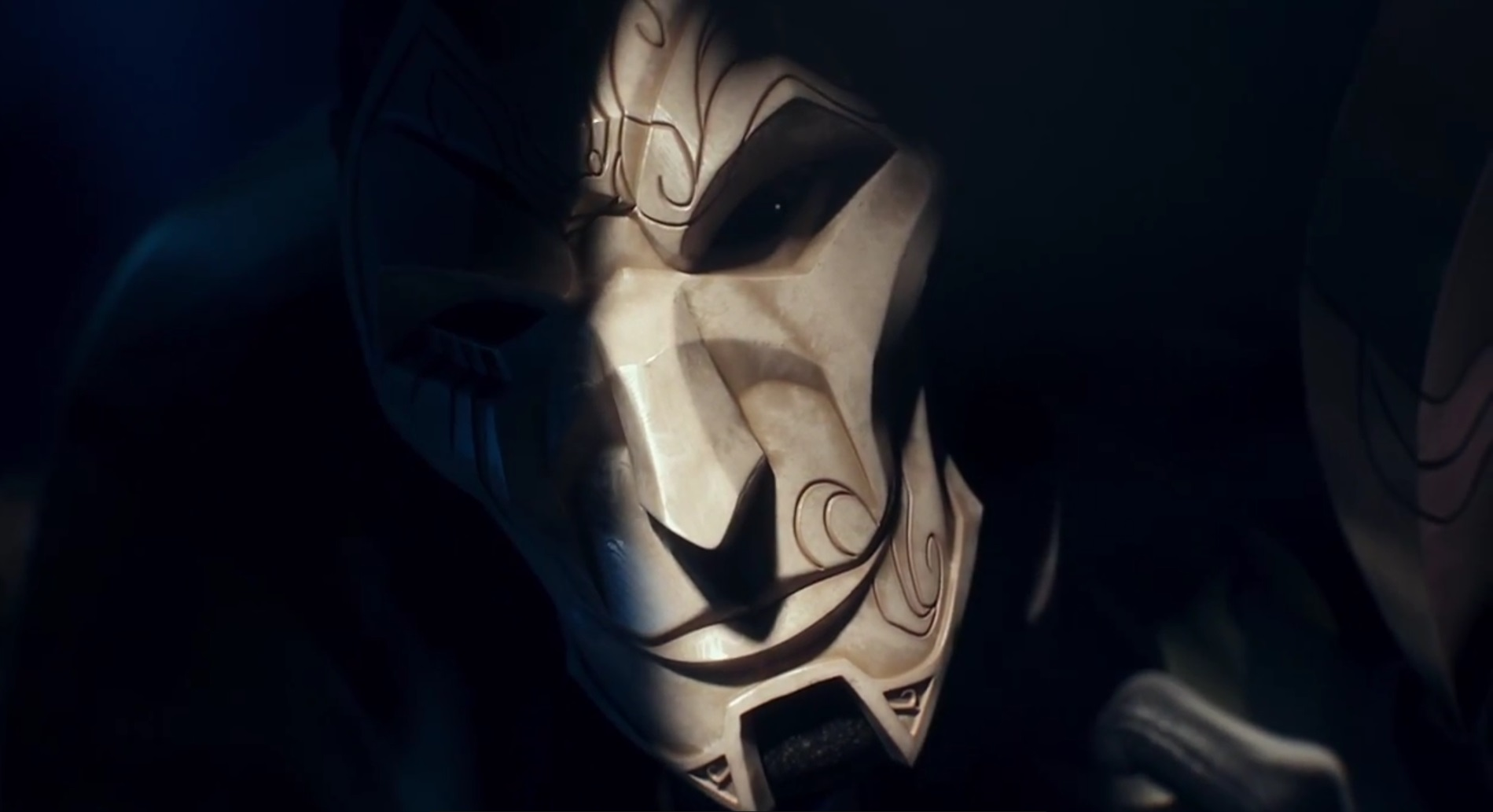
Jhin teaser image. Copyright Riot Games.
“I get nervous before every performance, but I need that feeling”. - one of Jhin’s movement quotes.
Now one might wonder if Jhin’s murderous tendencies reflect his own ideologies or is it just a mask? Here, we can look at it from a Jungian perspective, specifically through the lens of the persona. A persona is “a kind of mask, designed on the one hand to make a definite impression upon others, and on the other to conceal the true nature of the individual”, and it is acceptable as long as one knows one is not identical with the way one appears. It only becomes dangerous if a person overidentifies with it or unconsciously adopts it. However, it is not a disguise if he wears it over his true self, and in the case of Jhin, the persona has consumed the ego. Under the golden mask of ‘Khada Jhin’, there is nothing but the psychopathic murderer.
Donald Winnicott illustrated this concept with his own theory of the ‘false self’, which is a protective and compliant personality that develops in childhood to shield the true self from an environment that is not consistently supportive. While Jhin’s childhood is not exactly stated as being ‘difficult’, he still had to endure hardships due to his family not being as successful as one might like (his father’s dojo was overshadowed by the Wuju dojo of Master Yi). While this level of hardship might not be as significant per se, it might have helped in Jhin developing this ‘false self’, which then led to his crimes years down the line.
Ultimately, to live entirely through his golden mask means to live in exile from his actual self. However, what is most disturbing is that Jhin does not experience this as a form of exile. Instead, he is someone who has made peace in disappearing into said mask, which makes his fixation in turning murder into a form of art even scarier. The performer known as ‘The Virtuoso’ has taken over his ego as the name ‘Khada Jhin’ is now his main identity instead of what he was given as a child by his parents.
Interestingly, what Jhin experiences or does with his persona and characterization can be considered, in Freudian terms, failed sublimation. In psychology, sublimation is a mature type of defense mechanism, in which socially unacceptable impulses are transformed into more acceptable actions or behaviors. Prime examples of sublimation include turning aggression into sports, melancholia into art, or controlling tendencies into management. Here, Jhin has performed the transformation part (murder into art), but the result is not socially acceptable. In this case, he has found the form but not the civilizing function.
In a way, Jhin attempts the Jungian ‘royal art’, i.e., the transformation of darkness into gold. In a way, his masterpiece will forever remain unfinished because in its core, the transformation was tainted and its core remains incomplete.
Through Jhin’s story, we can learn about someone who aestheticizes violence and how someone’s identity can be dissolved into a murderous, psychopathic persona. In Ionia, he is just one of the perceived ‘villains’ in the grand scheme of the region’s narrative. However, Jhin is small fry in terms of the power level, but our next analysis will explore someone who is much, much more powerful.
Further reading
Carl Jung - The Archetypes and the Collective Unconscious
Susan Sontag - Regarding the Pain of Others
Donald Winnicott - The Maturational Processes and the Facilitating Environment
The Aesthetic movement (l’art pour l’art)
Reading Runeterra was created under Riot Games' "Legal Jibber Jabber" policy using assets owned by Riot Games. Riot Games does not endorse or sponsor this project.