
Conflict in Permanence: Kayn and the Architecture of Possession
Fighting over One Body
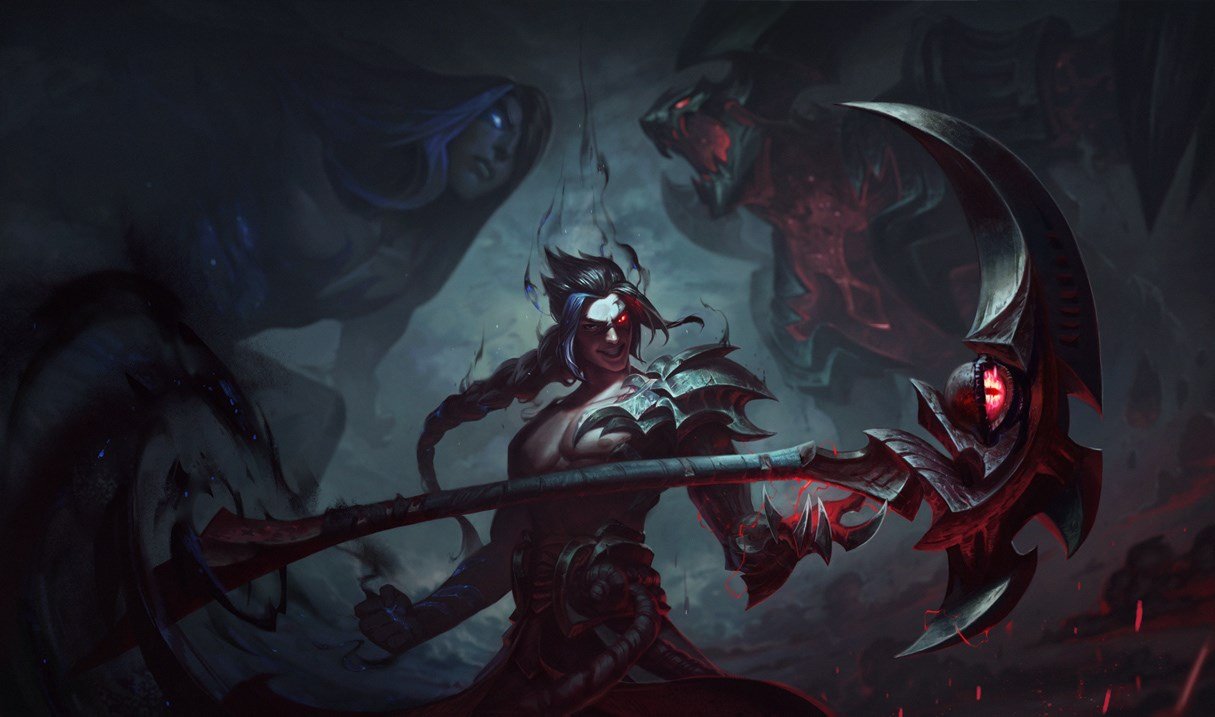
Classic Kayn splash art. Copyright Riot Games.
“Will you prove worthy? Probably not” - Kayn’s champion selection quote
Originally a Noxian child soldier sent to attack Ionia, Shieda Kayn was taken under the wing of Zed, the Master of the Order of Shadow, and was taught the ways of shadow magic and its weapons. After years of tutelage under his master, a single mission transformed Kayn's life forever. He, along with a few others from the order, was tasked with retrieving a Darkin scythe deep within Noxian territory. Having already mastered shadow magic from an early age, Kayn easily dispatched the Noxian soldiers and made a beeline for the scythe. As he approached the Darkin artifact, he heard voices as if trying to tell him something. After a murder attempt by a reckless soldier who tried to wield the scythe on his own, Kayn successfully subjugated the soldier and took the scythe for himself.
By wielding the scythe, he essentially shares his body with Rhaast, the Darkin sealed inside it. This led to the two entities vying for control of Kayn’s body, with the ultimate goal of consuming the other side. If Kayn’s own shadow magic wins, he becomes the Shadow Assassin; if Rhaast wins, he becomes the sole consciousness within the body, sealing Kayn somewhere beyond comprehension. His struggle against Rhaast in the same body can be explained through Hegel’s master-slave dialectic. There, he explained that each consciousness exists as a threat to the other; Kayn to Rhaast and vice versa. This is reflected in what essentially is their internal dialogue, with the most relevant example being this one:
Rhaast: “Rage inside me will not be contained”
Kayn: “The spade does not dictate the architect’s vision”.
Based on this, as explained above, both entities have different goals for the body it possesses; Kayn with his own pursuit in becoming the greatest Shadow Assassin and Rhaast with the goal of destroying everything in his wake, and when one of them completes this goal in the future, the other essentially becomes an intrinsic aspect that defined their previous shared existence.
Putting the ‘Shadow’ in ‘Shadow Assassin’
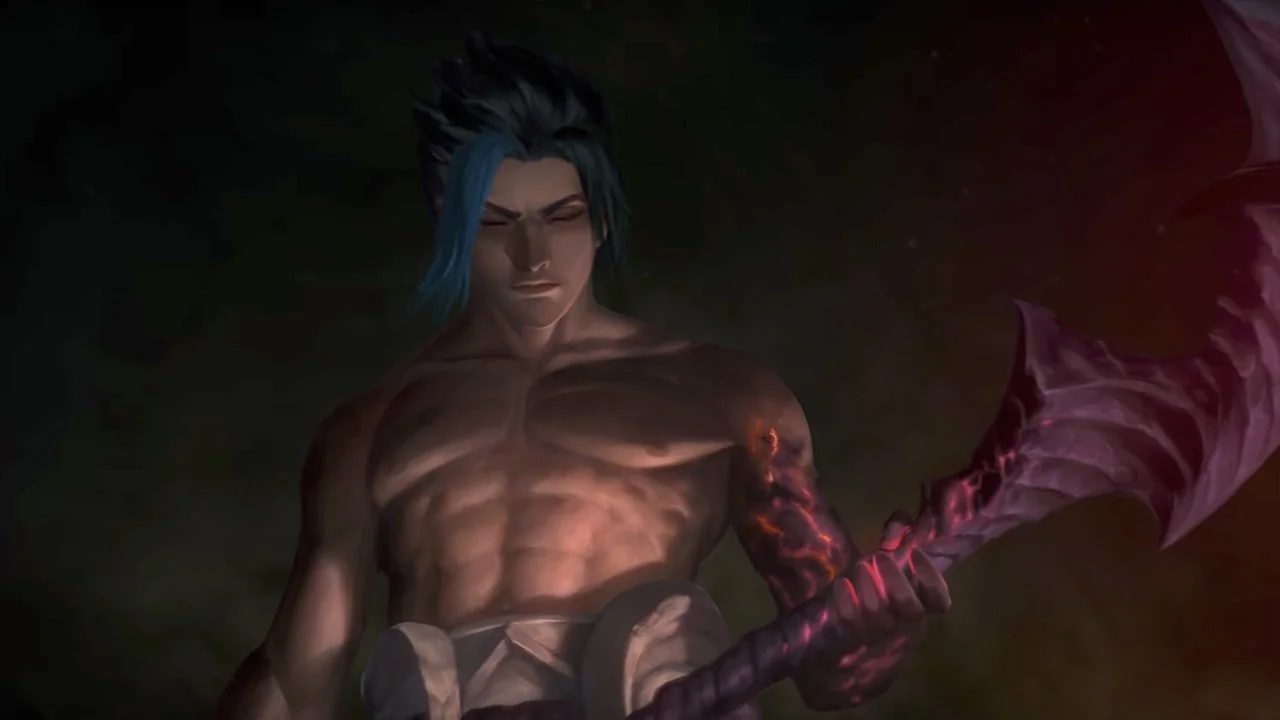
Kayn trying to wield Rhaast. Copyright Riot Games.
“The shadows reveal weakness.” - one of Kayn’s movement quotes.
Released in 2017, Kayn was the first champion to essentially have two completely different identities within one, well, champion. His game mechanics revolve around collecting orbs that contribute to his progress into either the path of the Shadow Assassin or Rhaast, with the former being attained by killing ranged champions and the latter by killing melee ones. This could be reflected in how the Shadow Assassin wants to stealthily kill vulnerable targets (ranged champions generally tend to have lower hit points), whereas Rhaast wants to destroy and wreak havoc, being a threat that is not as easily taken care of compared to the Shadow Assassin. Simply explained, the Shadow Assassin focuses on high burst damage and mobility, whereas Rhaast focuses on sustained damage and crowd control.
Building on the previous part about the master-slave dialectics, we can also apply the Jungian shadow into Kayn and Rhaast. Ever since getting his hands on the Darkin scythe, Rhaast has been a part of Kayn’s existence and represents a side of him that is “different” from his regular self. However, Kayn’s ultimate goal is to harness Rhaast’s power for himself and become a more powerful version of himself, ideally surpassing the powers of his master in the Order of Shadows, Zed, who has mastered shadow “magic” for as long as Kayn has been alive. It is quite interesting that, regardless of Riot's intentions while writing and developing Kayn, the main conflict of him becoming a Shadow Assassin also explores the Jungian shadow, or more specifically, the attempt to eliminate said shadow in the form of eliminating Rhaast.
That said, drawing on philosophical concepts in agonism (a political and social theory that emphasizes the potentially positive aspects of certain forms of conflict), we can ask the following question: who is Kayn without Rhaast? The lore explores the notion that irrespective of him wielding Rhaast or not, Kayn is already a powerful wielder of shadow magic, but the Darkin scythe opened him up to powers beyond his wildest imagination, and thus his pursuit for domination ultimately relies on eliminating the Darkin and taking the powers for himself. However, should he become the Shadow Assassin, does he just become a mindless killing machine due to the Darkin’s previous influence? Or something completely different?
This positions Kayn as purely an assassin with little to no semblance of humanity that finally reached his zenith as a wielder of shadow magic and surpassed Zed. While a master in the arts, Zed is still “human” enough not to recklessly use his powers, as explained in his self-titled comics that explored his reluctant cooperation with childhood friend and former rival Shen in acting for the “greater good of Ionia." However, in Kayn’s case, that is completely gone since he has been described as “crazy” by other characters and is a wildcard in the grand scheme of things.
Corruption of the Child Soldier
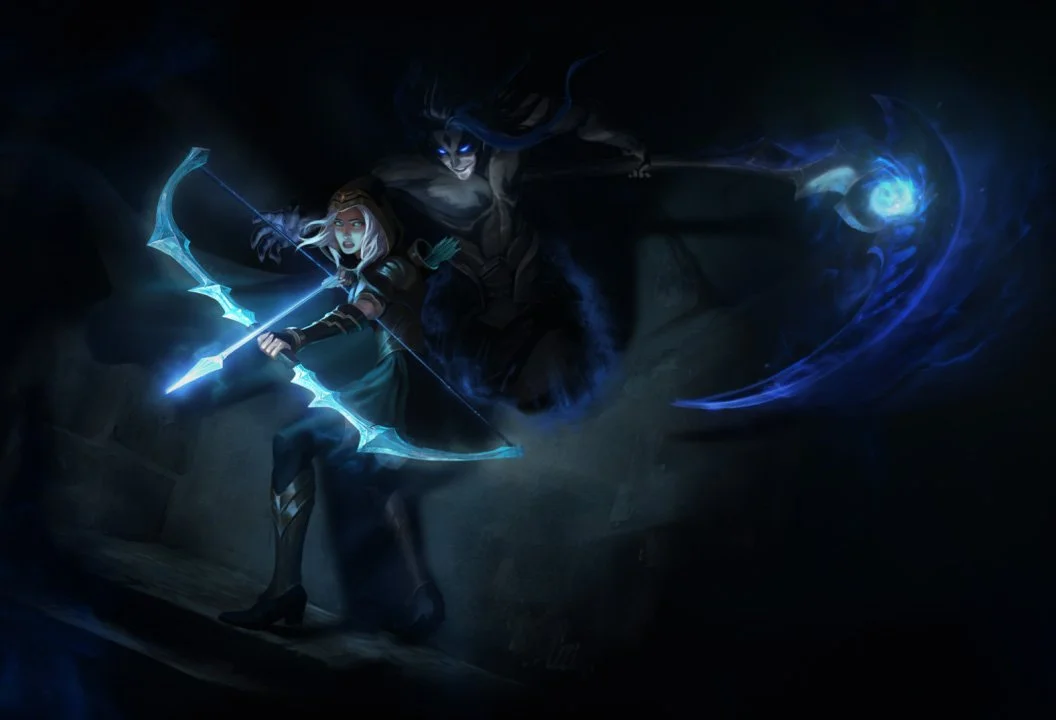
Kayn when he transforms into the Shadow Assassin. Copyright Riot Games.
“The child is gone. The killer remains”. - Quote when Kayn transforms into the Shadow Assassin.
The lore explained that Kayn was already conscripted at ten years old, and child soldiers are vulnerable to indoctrination and eventual contribution in extremism, which is why terrorist organizations recruit children even as young as four years old to join their ranks and practice their ideology. In the case of Kayn, he was initially recruited under the Noxian banner but was then adopted into the Order of the Shadows by Zed. While under the tutelage of Zed, he was given food, shelter, and a purpose, but the purpose was killing and eliminating threats. He progressed further and faster than any of his contemporaries, which led to his acquiring arrogance and hubris over the years. Combine that with wielding a so-called weapon of mass destruction and an evil entity awakened after thousands of years? It is a recipe for disaster.
Here, we can draw upon the works of Judith Herman in the field of complex trauma and captive environments. War and conflict significantly contribute to someone’s trauma, and in the case of Kayn, it is no different. In his case, his initial wound as a child soldier was ‘healed’ by being adopted into the Order of the Shadow, where he was fed, taken care of, and put under tutelage. While this sounds positive, it ultimately enables Kayn’s traumatic past as a child soldier who had to be more competent than everyone and thus brought upon his hubris and arrogance.
This means that while in the Order of the Shadows, Kayn was already indoctrinated by Zed and, later on, after getting a hold of the Darkin scythe, had to share a body with an ancient entity in Rhaast. So basically, ever since his conscription, he has had no identity to call his own; he either had to follow a master or share his body with someone (or thing) else. As such, a victory over Rhaast would finally mean physical independence, and becoming the ultimate Shadow Assassin would signal an ideological one, as he perceives that Zed ‘holds him back.'
So, what does this mean for Kayn’s future as the Shadow Assassin? Well, in the future narrative of the lore of League of Legends, it might set up future narratives relating to the Kinkou Order (who may perceive Kayn as a disturbance to Ionia’s balance), and the Order of the Shadows (where Zed would finally confront the monster he created), or Kayn’s revenge mission against Noxus, who conscripted him as a child.
Previously in the Varus essay, we explored how three entities (sort of) symbiotically share one body, and this time with Kayn, we explore the eternal conflict between two entities trying to eliminate one another. Next time, we will explore another Darkin, but this time, his legend does not involve prophetic calamity or destruction but a legacy of honor and protection of Ionia.
Further reading
G.W. Hegel - Slave-Master dialectic
Judith Herman - Trauma and Recovery
Carl Jung’s concept of the shadow
The concept of agonism
Reading Runeterra was created under Riot Games' "Legal Jibber Jabber" policy using assets owned by Riot Games. Riot Games does not endorse or sponsor this project.