
Zaahen and the Legacy of the Unsundered
The Responsibility and Guilt of Ascension
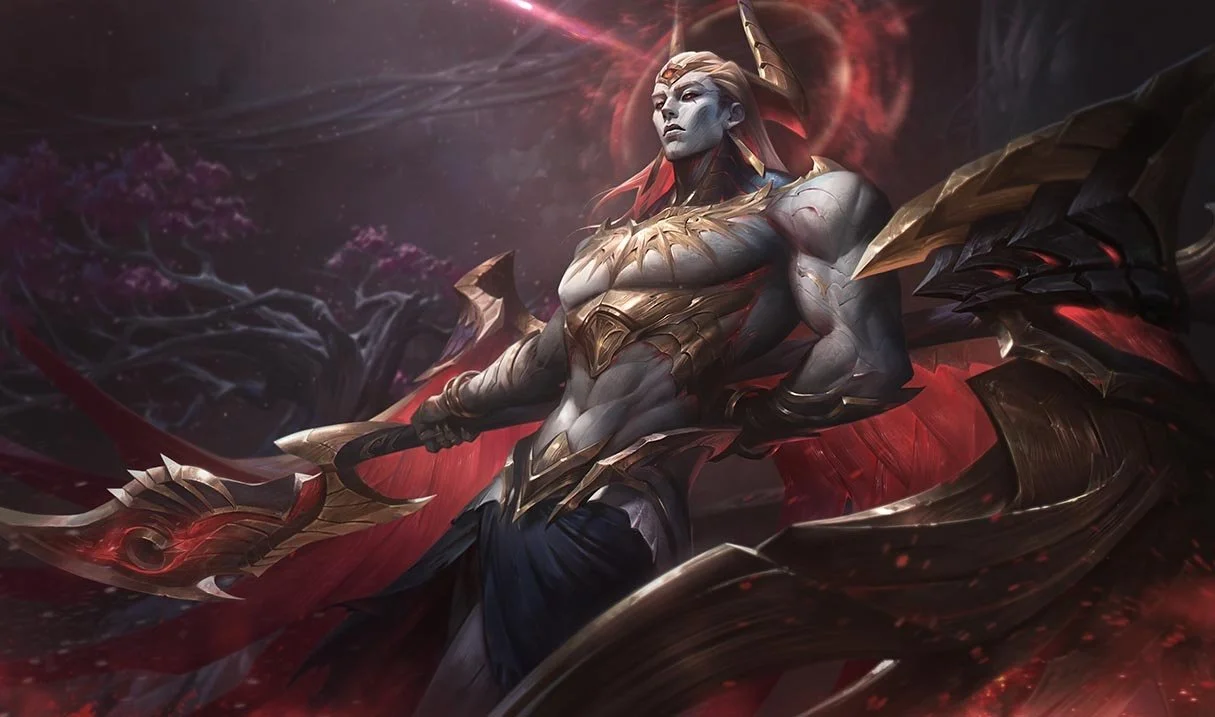
Classic Zaahen splash art. Copyright Riot Games.
“I rise in rage for what we have become and reverence for the gods we once were. I rise with the pride of our great kinship and the pain of betraying it in bloodshed. Clinging to broken vows and broken brotherhood, the divine and profane war within. Yet in battle they find the same purpose: fight on. In this, I am whole. In this, I can silence all disquiet, carve away doubt, rise above my suffering. - Zaahen’s internal monologue in the story, The Unsundered.
Out of all the Darkin that have been explored in the narrative plot of League of Legends, only one stands out as a perceived force of ‘good’: Zaahen. Five thousand years before the main story of League of Legends takes place, Zaahen was a noble warrior from Shurima who eventually ascended into godhood alongside the likes of Aatrox and Rhaast. While this ascension, like the aforementioned two, transformed him into a Darkin, he retained most of his sanity and nobility, which the two had lost after their respective transformations. Due to the destructive nature of the Darkin, he fought alongside humans to prevent the world from going into ruin, ultimately learning about the ability to seal the Darkin inside their own weapons.
However, since he feared his own downfall, he requested the Kinkou Order to seal him within his own glaive in the Temple of Twilight, and to this end, the Fist of Shadow, Yunara, was tasked to monitor his glaive in the Spirit Realm for the next one thousand years. Centuries later, LeBlanc of the Black Rose sought to claim the glaive for herself and summoned the demon Atakhan. A fight ensued between Atakhan, Yunara, and the Seneschal of Demacia, Xin Zhao, and the latter sacrificed himself so that Zaahen could take over his body to ultimately defeat the demon. After a successful subjugation, Zaahen quietly left and Yunara took Xin Zhao’s spear back to Demacia, where he was given a proper hero’s burial.
The story of Zaahen is one that can be defined by responsibility and legacy. First of all, he was the one who ‘supervised’ the ascensions of Rhaast and Varus, among others, which led to him feeling responsible for their eventual downfall into Darkin and a trauma that he would fall like them as well. This can be explained through Bernard Williams’s concept of ‘agent-regret’, which means that even though we did not directly contribute to bad events, we feel at fault for said events. For example (this might get dark), your friend ends his life after a long battle with depression. Even though you were not directly at fault for his suffering, you start to reflect on the moments where you could have played a role in his suicide, like not answering his calls that one night because you were busy with work or unintentionally downplaying his achievements. This is why Zaahen tries to prevent his own downfall, because he knows that what he supervised thousands of years ago might lead to the destruction of the world and if he becomes corrupted, he will become a harbinger of doom like the others.
The Moral Act of Self-Confinement
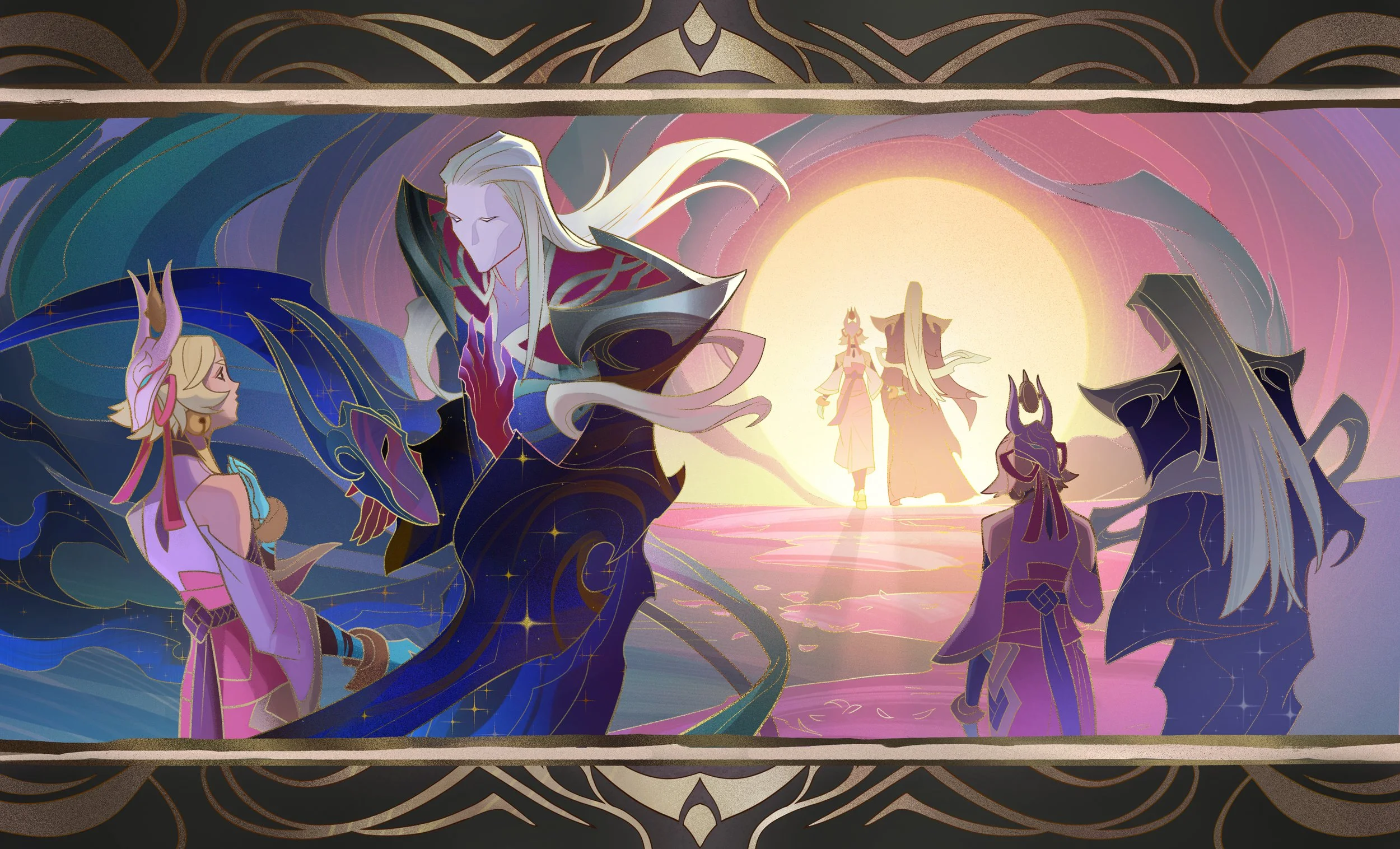
Still from the motion comic, The Devoted Shrine Maiden. Copyright Riot Games / Kristina Atanasoski / Kudos Productions.
“Beneath my wings, the Sunborn joined me in immortality. Now, beneath my blade, they must die”. - one of Zaahen’s long move quotes.
A key element in Zaahen’s story is his self-confinement inside his own glaive. He prevented his own downfall by essentially ‘sacrificing’ himself so that he does not bring ruin to the world. His glaive would then be sealed in the Temple of Twilight and was moved to the spirit realm so the mortal realm could continue to exist ‘normally’. Here, to heal Ionia from the trauma of the War of the False Kanmei, legends were told of the Shrine Maiden (Yunara) and the Mighty Spirit (Zaahen) who won their battle against the forces of evil (the Darkin). Here, the concept of virtue ethics is at play. There are two types of persons here; the resistant person and the truly virtuous person. In the case of Zaahen, he is the former as he knows that he can be corrupted or fall to the dark side, yet he continues to resist and fights for the ‘force of good’, so to say. This is why his relationship or camaraderie with Yunara is key in his character arc. He believed that she wanted to free him, but they both knew that she could not. Also, her presence was one of the key factors keeping him ‘sane’, so to say, as Yunara would be the one repelling the azakana (demons) who came and tried to attack him.
Preventive self-restraint is a common act in dealing with the trauma or propensity for violence. For example, someone with an alcoholic past will try as hard as they can to keep alcohol as far away as possible. While it is relatively easier to put actual objects at a reasonable proximity, when it is internal, it can get difficult. In Zaahen’s case, violence and destruction exist as part of a Darkin’s predisposition and can be triggered at any time, as seen in the cases of Rhaast, Varus, and the other Darkin. As such, he puts himself in the best scenario to not transform or become the other ‘fallen’ Darkin by essentially sealing himself in his own weapon in a realm where evil cannot penetrate as easily.
One thing that I will highlight in Zaahen’s eternal conflict is that it sort of applies the concept of anicca in Buddhism. It means that the self is always in process and virtue is not a state, but a practice in which we must always apply to be a ‘good’ person. In his case, what is important is his continuous and eternal effort to do good, not the achievement of being a good person. By sealing himself in his glaive and not letting Yunara free him at any point during his thousand-year stay at the Temple of Twilight, he has already prevented himself from falling to the dark side and keeping the peace that came after the War of the False Kanmei and the final aftermath of the Great Darkin War.
To this end, Zaahen’s deification as the Mighty Spirit resonates with the people of Ionia and would ultimately become the thing that spurred his eventual comeback more than one thousand years after his self-imprisonment. By taking over the body of someone with a noble spirit in Xin Zhao and defeating the demon Atakhan, he succeeded in doing the good that he strived for after a thousand-year-long slumber.
The Voluntary Host
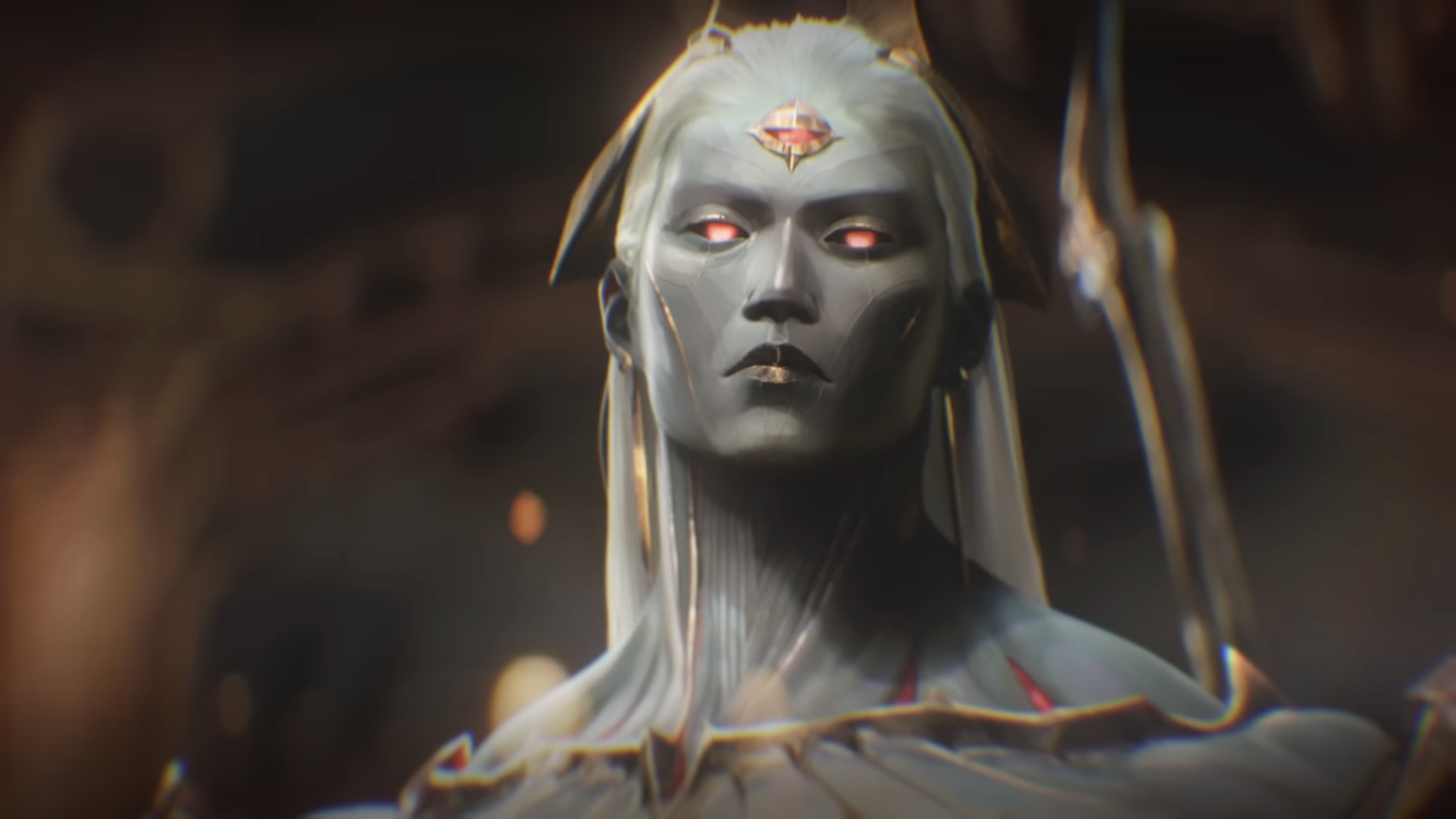
Zaahen after taking Xin Zhao as his host in the cinematic, Twilight’s End. Copyright Riot Games.
“Seneschal, resolute even in the fields of memory—we rise as one”. - Quote when Zaahen encounters Xin Zhao in-game.
Zaahen’s release in League of Legends coincided with the end of the final thematic season of 2025, which was aptly called Trials of Twilight. The final cinematic of the season, titled Twilight’s End, saw the death of Xin Zhao and Zaahen taking his body to defeat Atakhan. As a mortal, Xin Zhao was not equipped to deal with demons such as Atakhan, and knowing his dire situation, he pleaded with Zaahen to take over his body and defeat the demon.
In this situation, the relationship between the host and the Darkin is consensual, which is not like the other cases, such as Rhaast having to coexist with Kayn in one body which has a clause of finality within it (one of them must eliminate the other) or Varus being an amalgamation of three consciousnesses at the same time. Here, Xin Zhao willingly sacrificed himself for the greater good and essentially gave Zaahen his mortal body, which he would then duly utilized to perfection as Atakhan was defeated.
The debate here lies in the ethics of Xin Zhao’s sacrifice. He decided by his own will to sacrifice his body to Zaahen, but was it an ethical one? Here, Zaahen was put in a difficult position as he was the recipient of a sacrifice he did not ask for. By this, I mean that he did not want to be freed; he was quite comfortable in preventing himself from succumbing to darkness by staying inside his own glaive, yet the direness of the situation made him take on Xin Zhao’s body to defeat the threat to the spirit realm.
Based on his title as ‘The Unsundered’, Zaahen represented a being who resisted the sundering that ultimately changed the fate of his kind, i.e., the Ascended who eventually became the Darkin. Even though he is a Darkin, his legacy or role in the grand Runeterra narrative is one of protection, mentorship, and sacrifice. His design in the Twilight’s End cinematic represents his role as some sort of priest who led his brethren to the sacred dais known as the Sun Disc in ancient Shurima. He was the last thread of existence who knew the previous state of the likes of Rhaast, Varus, and other Darkin who took part in the ascended ritual.
Should the narrative surrounding the Darkin be brought forward in the future, there is a chance that Zaahen will play a key role in the prevention of the destruction of the world of Runeterra. Also, should he sacrifice himself once again, we might see Xin Zhao return from the dead and be part of a future story relating to Demacia or Ionia.
Sacrifice is a key term not only in the narrative of Zaahen, but also in Ionia in general, and what greater sacrifice is there than to remove yourself from the mortal world to guard what essentially is a weapon of mass destruction? But, for now at least, the time has come for her to finally prune the tree.
Further reading
David Sussman (referring to Bernard Williams) - Is Agent-Regret Rational?
Daniel Susser - Predictive Policing and the Ethics of Preemption
John Milbank - The Ethics of Self-Sacrifice
The concept of anicca in Buddhism
Reading Runeterra was created under Riot Games' "Legal Jibber Jabber" policy using assets owned by Riot Games. Riot Games does not endorse or sponsor this project.