
Varus: An Exploration into the Identity of Retribution
The Descent into Madness
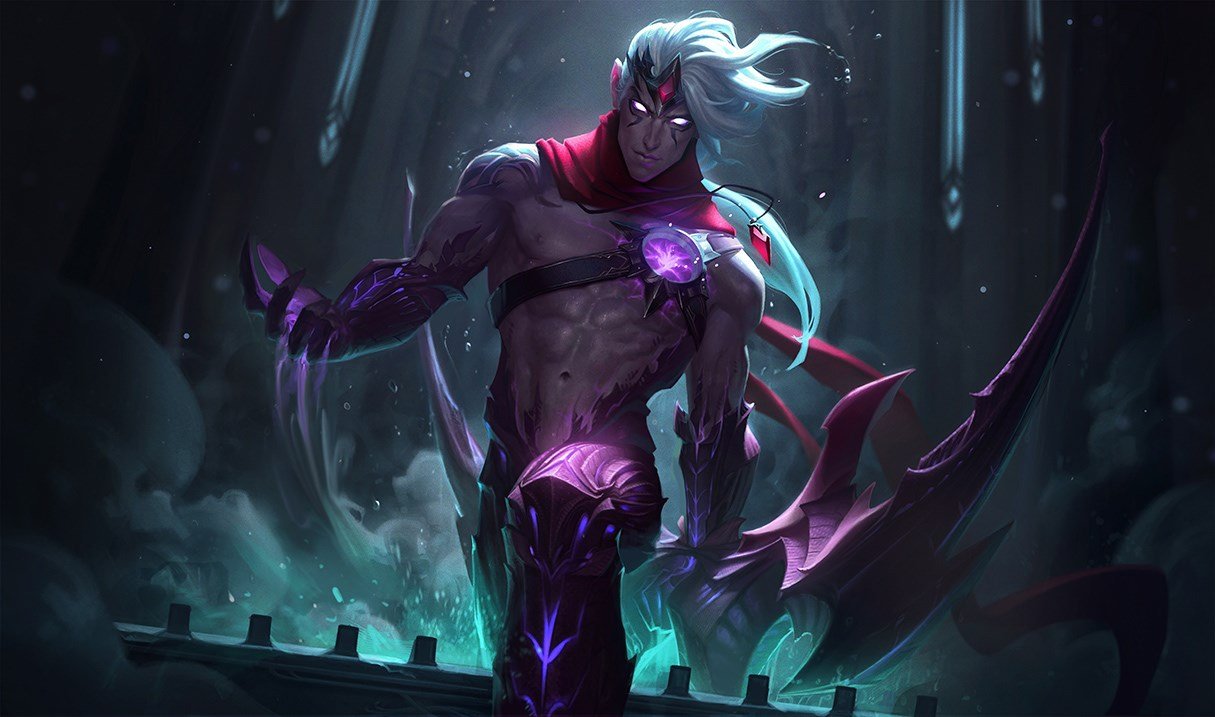
Classic Varus splash art. Copyright Riot Games.
“The guilty will know agony” - Varus’s champion selection quote
The story of Varus is one of tragedy and misfortune. Once an honorable paragon of justice as a temple warden thousands of years ago, he was consumed by anger and revenge after the downfall of his people during the Icathian rebellion, which led to him taking part in the Ascension ritual and transformed him into a god-warrior. However, despite his newfound powers, his lust for revenge remained and for centuries, it would corrupt him to the point of no return. He, along with his fellow Darkin (ascended beings who became corrupted) brethren (such as the champions Aatrox, Naafiri, and Rhaast), initiated the Great Darkin War 1500 years before the current timeline of League of Legends, but through the intervention of Zaahen (who is also a Darkin but not corrupted) and the Kinkou Order (which, at that time, included champions Kennen and Yunara), Varus, along with the other Darkin, were sealed in their respective weapons and hidden far away from civilization. That was, until the modern era, a pair of hunters stumbled upon the pit where Varus was hidden and brought him back to life, but with a massive caveat: instead of being resurrected in his former ascended form, the new body is an amalgamation of the two hunters who inadvertently resurrected him, each fighting for its control.
From this introduction, Varus is narratively interesting. By this, I mean that his ‘self’ consists of three entities; the Darkin ‘Varus’, Valmar, and Kai (the two hunters, who were also lovers). According to the lore, Varus’s penchant for vengeance is echoed by Valmar (who has a hatred towards Noxians, the nation that tried to kill both him and Kai), whereas Kai provides a more ‘peaceful’ voice to the narrative, questioning the other two personalities should they go off the rails in enacting vengeance. The dynamics of an ancient ascended being vying for control with two mortals for one consciousness pose an interesting question that needs to be answered: who is Varus exactly?
With the implementation of Valmar and Kai into Varus’s identity, one can assume that this amalgamation of three consciousnesses is the new ‘Varus’, whereas others might consider it to be a completely new entity. Here, we can refer to Assmann’s theory of collective identity, but instead of implementing it to a culture, we apply it to the lived experiences of the three entities inside Varus. For example, we can take three events that were experienced individually: Varus being sealed inside his bow inside a well in Ionia, Kai being fatally wounded by the Noxian attack, and Valmar taking Kai to the well where Varus was sealed. Since all three essentially conjoined into one coherent being, the new Varus lived all three experiences.
The Arrow of Retribution
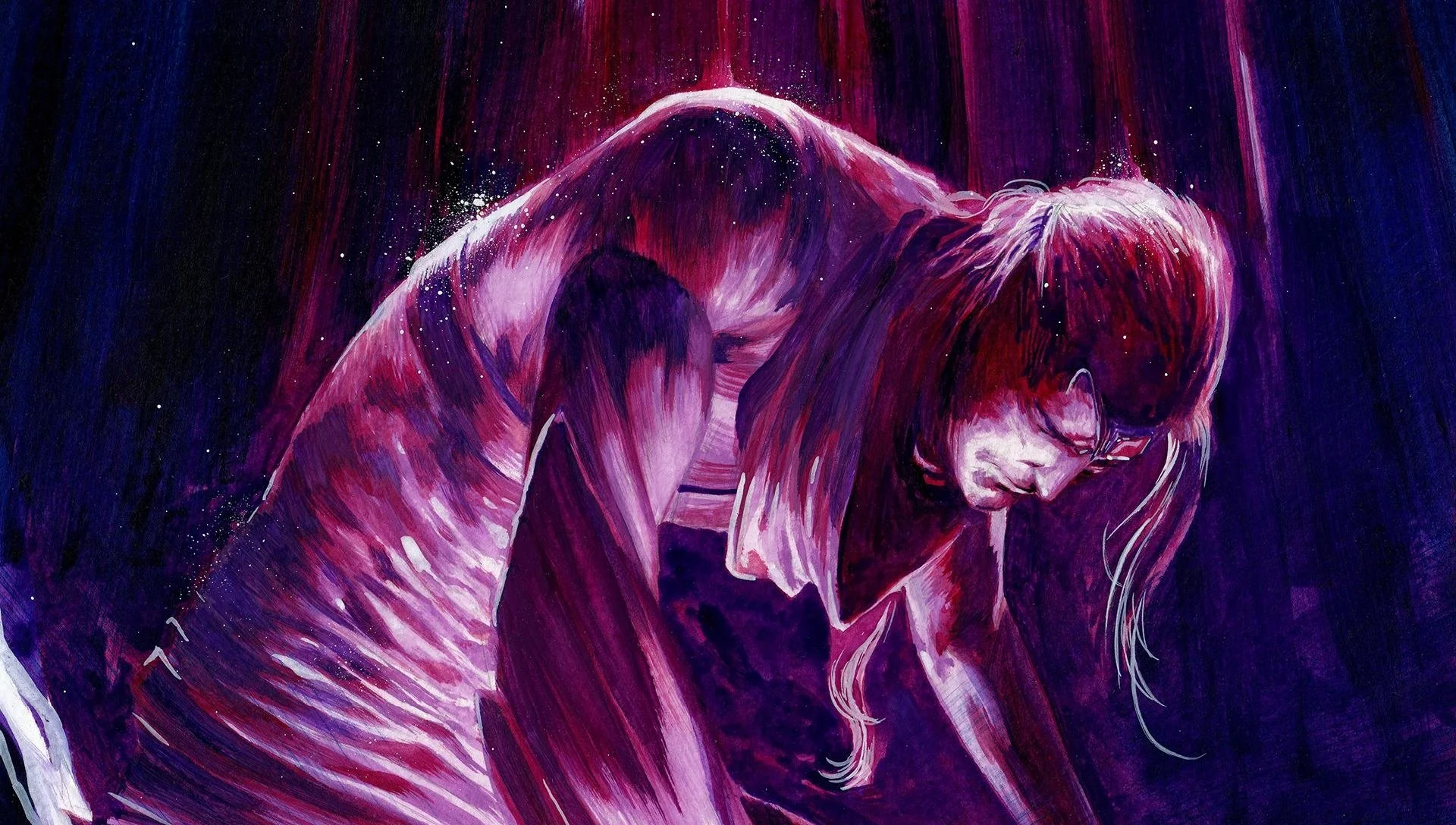
Varus, as depicted in the comic, Retribution. Copyright Riot Games.
“You didn’t destroy us all. And that mistake will be your undoing.” - one of Varus’s lore quotes.
From his introduction nearly fourteen years ago, his title as ‘The Arrow of Retribution’ remains unchanged, despite the retconning of his lore from an Ionian temple guardian to an ascended Darkin god-warrior who was sealed within his own bow. Retribution or vengeance is a key component in Varus’s lore and it cannot be reduced to a simple act of justice. For example, if I took the last piece of cake even though you wanted it, and next time you did the same to me, then the loop is closed and the justice has been successfully ‘distributed’. However, for Varus, vengeance is his identity, and for thousands of years ever since his entrapment in his own bow, that has been the goal, hence his champion select quote.
Here, we can draw from Nietzsche’s analysis of revenge in On the Genealogy of Morality. Here, he introduced the concept of ressentiment (not to be confused with resentment). The main difference between the two is that ressentiment represents a deep-rooted hatred that causes individual weakness and involves a sense of powerlessness that is not easily alleviated. In the case of Varus, this is present in how he always needs to reassert his identity as the ‘vengeful Darkin’ against the other two identities of Valmar and Kai, yet he cannot do anything about it since they are now one. However, this is not the only case of him harboring deep-seated hatred. The event that corrupted him in the first place thousands of years ago still plays a major role in his identity, which is why even after such a long time, he is still vengeful towards those who wronged him, hence his passive skill name of Living Vengeance.
In this case, we can understand that the act of vengeance is something that produces rather than represses. Violence and corruption are acts that are produced through individual agency (i.e., someone acts violent towards another and/or a person corrupts another). What Varus wants is to unleash this violence towards those who wronged him and enact his own form of retributive justice, so much so that vengeance is the identity in which Varus built himself upon.
However, vengeance and hatred only constitute one part of Varus; the other two represent the opposite: love. Valmar and Kai’s love for each other is keeping Varus from completely losing himself and basically bringing forth calamity. In this case, the two forces (counting Valmar and Kai as one ‘positive’ force) are basically trying to one-up each other in establishing the main identity of Varus, creating a never-ending dissonance of identity. Through this, as well as based on predictions of the future of the lore of the game, there is a chance that as cheesy as it sounds, Valmar and Kai’s love for each other might be the force that prevents Varus from completely losing it or even push him to an eventual redemption arc, such as depicted in the Arclight Varus skin.
The Gender Identity of Varus
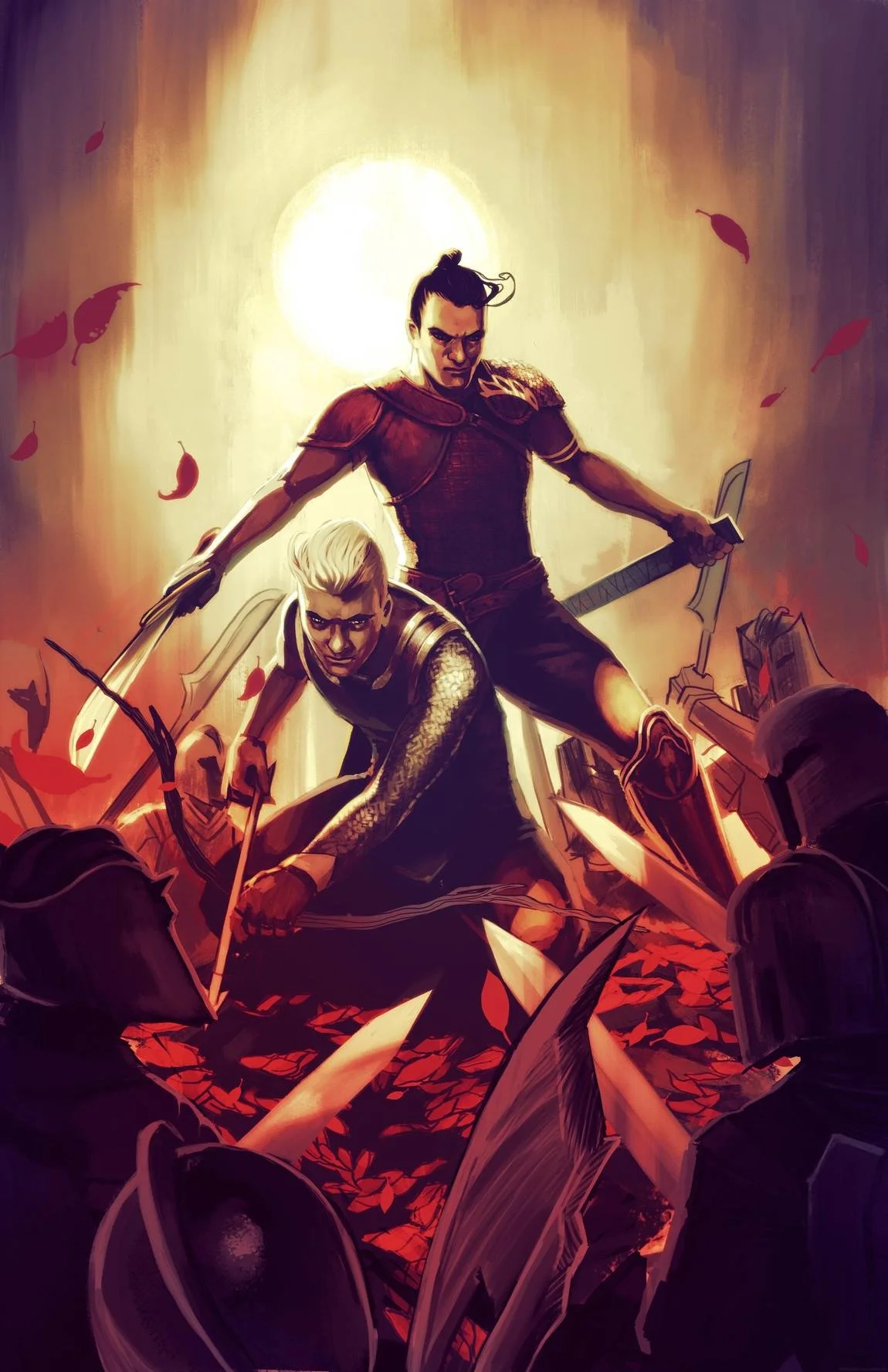
Valmar and Kai. Copyright Riot Games.
“Grief is the key, turned by loss. One needs only the glimmer of hope. That sound you hear is an arrow of retribution”. - Quote describing Valmar and Kai before entering the temple where Varus was sealed.
The exploration of Varus as a character also means exploring his identity. As described in the official League of Legends wiki, all three entities inside the Varus body are male, and therefore he is, by default, a male. However, where this can get contentious is by trying to answer the following question: if Valmar and Kai are lovers, does that make Varus gay?
Well, Riot Games themselves have classified Varus as an LGBTQ+ character, being the first to be officially assigned as so after the release of the music video As We Fall in 2017. From here, we can concur that the Darkin also takes over the sexual identity of the two men inside his consciousness. A useful framework that we can use is Eve Kosofsky Sedgwick’s Epistemology of the Closet, which explores the ‘non-binariness’ of homosexuality. There are two views in which one can guide sexual identity and desire, which are the minimizing view (certain people are born gay and only attract gays) and the universal view (homosexuality is a spectrum). Here, I am simplifying both to get the point across as easily as possible, even though what Sedgwick wrote in her book is more complex than that.
This then led to this interesting question: if the one who reawakened Varus was, for example, a woman or a heterosexual person, does that change Varus’s gender and sexual identity? One of the observations found in the official wiki entry was that because Varus consists of basically a three-in-one package, his pronouns are they/them, which makes everything more convoluted and that this entire essay had been misgendering Varus this entire time. But, for the sake of simplicity and the masculine identity of all three entities inside him, I will use he/him to describe Varus as a single entity. Going back to the problem at the start of this paragraph, what I think would have happened if, for example, a woman was responsible for Varus’s resurrection instead of Valmar and Kai is that Varus’s gender identity would be completely different. This mainly stems from the issue that while the original Varus was male, his sexuality was not defined and ultimately drew upon the identity of the couple that resurrected him. The thing is, most if not all Darkin characters and champions do not have their sexualities defined anyway.
From this perspective, Varus can be read as a queer narrative congregation that posits that identity is neither singular nor stable, and based on his narrative journey, this might even change in the future, which makes his story even more compelling. With the power of the Darkin being a key component in the greater Runeterran narrative, it stands to reason that scenarios involving the Arrow of Retribution may come into fruition, such as Varus eventually consuming both Valmar and Kai and becoming a single entity or the two hunters finally finding the ‘cure’ that unbinds them from the Darkin entirely.
Through Varus, we explore not only how powerful the Darkin actually are, but also how they influence the narrative progression of certain characters. Also, they provide a compelling exploration in elements such as gender identity in three entities living in one body. So, what happens if those entities are permanently at war with each other until one side ultimately gives up?
Further reading
Friedrich Nietzsche - On the Genealogy of Morality
Judith Butler - Gender Trouble
Eve Kosofsky Sedgwick - Epistemology of the Closet
Riot Games - As We Fall
Reading Runeterra was created under Riot Games' "Legal Jibber Jabber" policy using assets owned by Riot Games. Riot Games does not endorse or sponsor this project.