
Continuity as Resistance: Xayah, Rakan, and the Memory of Ionia
Names and Orientation
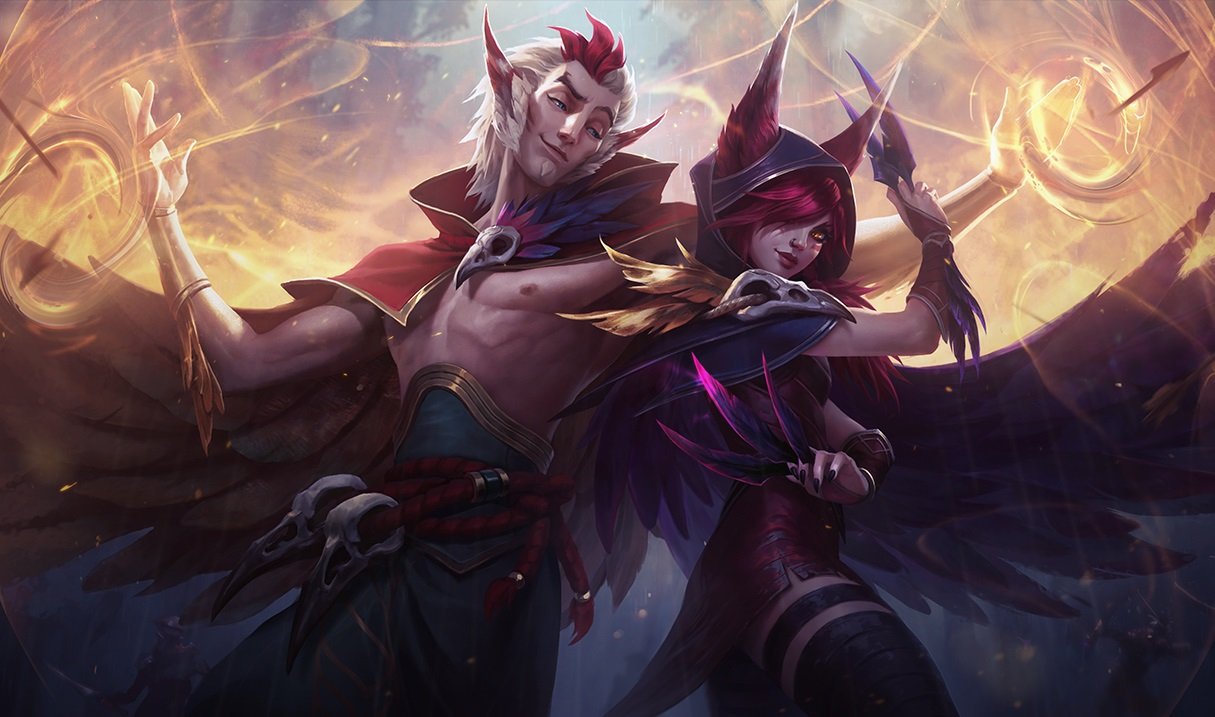
Classic Xayah (right) and Rakan (left) splash art. Copyright (C) Riot Games
“I can never resist an invitation to dance!”/“Let’s dance!” - Xayah and Rakan’s champion selection quotes
Now that we have explored the concept of identity and “the self” through Ahri, the next step of this exploration of Ionia takes place in the form of an iconic Vastayan duo, Xayah and Rakan. Etymologically, their names take inspiration from two languages from the Austronesian branch in the form of Malay and Bahasa Indonesia, with Xayah deriving from saya (the Indo-Malay word for the first-person singular “I” or “me”) and Rakan from, well, rakan (or rekan in Bahasa Indonesia), which means “friend”. In professional contexts, this can also be used to depict “colleague” or “acquaintance” (i.e., rekan kerja or “work colleague”). In the case of these two Lhotlan (bird-like) Vastayas, the shared etymology is not just an application of linguistic symmetry, but also a conscious decision in establishing these two champions as a couple.
Xayah and Rakan are not just a couple in the grand scheme of Ionia or Runeterra, but one that synergistically and thematically works. Both names are short and melodic and neither encodes status or title (i.e., they’re just “Xayah” and “Rakan”). Also, linguistically, Xayah’s name reflects her steadfast presence and assertion of her title of “the Rebel”, focalizing herself as “the alpha” in this relationship, whereas Rakan, “the Charmer”, is the one who socializes and befriends others to further his partner’s cause. We can refer this to the concept of the “signifier” and the “signified”, as posited by de Saussure, especially when it comes to how these characters represent their identities and names in the grand scheme of their relationship.
When combined together, two meanings can be created. “Xayah-Rakan” (read: saya rakan) means “I am a friend” and “Rakan-Xayah” (read: rakan saya) means “my friend”. In both cases, Rakan is positioned as the “friend” (or in the context of their relationship, the “partner”), which positions Xayah as the focal character. While not exactly relevant to the ultimate thematic of this project, we can look into how the two function in-game. Xayah is an attack-damage marksman who utilizes her skillset to do as much damage as possible, whereas Rakan is a supportive character who provides healing, shielding, and crowd control.
In conclusion, their etymology reflects and represents not only how the world they live in work, but also how their interactions bring meaning to the context of their in-world relationship.
The Revolutionary and the Witness
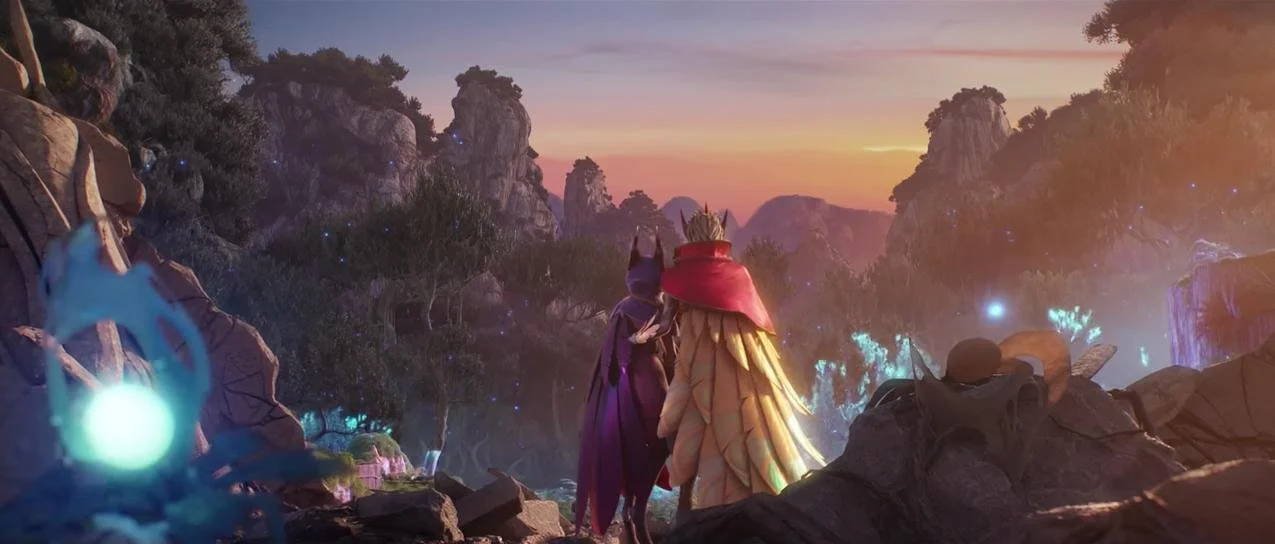
Xayah & Rakan still from the cinematic, Wild Magic. Copyright (C) Riot Games
“I got freedom. I got a lady. I got a cause to die for”. - quote from Rakan’s biography story.
Ionia is a region synonymous with terms such as “preservation” and “balance”. Yet, in the case of Xayah’s life as a Lhotlan Vastaya, she represents a figure who pursues those goals through her identity: bravely and unapologetically herself. Working mostly alone, she believed that her accomplishments were second to none. That was, until she met fellow Lhotlan Rakan. In this context, what was believed to be Xayah’s whole identity (a brave and rebellious fighter who fights for the preservation of Ionia) was positively altered. Not in the context of the Ionian “self”, but in the context of the “collective”.
In the previous text discussing Ahri, in Ionia, the “self” only survives as long as its experiences remain coherent. In the case of Xayah and Rakan, however, this is extended to also influence the collective. In other words, where Ahri’s sense of the “self” is changed by absorbing the lived past of others, Xayah and Rakan represent this on a collectivistic, cultural level. If a culture (in this case, the Lhotlan Vastayas) depends on continuity, someone representing said culture must determine this: what counts as continuation here?
Even though it is established in the lore that Rakan is the one who talks more and integrates with the social groups they encounter, their story advances through Xayah’s interpretation of events, establishing her as the focal character. We can look at this from the lens of feminist narratology that answers the question of “whose perspective counts?” Susan Lanser’s concept of narrative authority helps in exploring this concept: authority is not established by the dominant force, but rather the one who gives the narrative meaning, and in this case, it is Xayah.
This, however, does not mean Rakan’s role is simply comic relief or a supplement to Xayah’s existence, rather that he keeps Xayah’s mission intact and serves as the emotional core in the relationship. Without Rakan to keep her emotionally in check, Xayah becomes robotic. As such, one can describe their relationship as so: Xayah preserves, Rakan affirms. This is a departure from traditional storytelling’s role in which the male takes on a more active role and the female the passive one, yet here, the inverse works because of their respective character depictions.
Harmony Requires Two Positions

Photo by Prasanth Inturi
Victors are the sole authors of history. Time to write our chapter. - one of Xayah’s long move quotes
Based on the themes explored in this essay, we see that Xayah appears to be the one with the political compass, hence her title of “The Rebel” and Rakan being the one who makes sure that his partner’s political message is delivered, hence “The Charmer”. In the context of Ionian storytelling, however, this message can be interpreted as “what are they trying to preserve?” In this case, if identity depends on continuity, are these two, theoretically, trying to “preserve” the continuity of Ionian identity?
Susan Lanser’s work on narrative authority reminds us that it lies not in who is the perceived “dominator” in this context, but rather the person or perspective that gives the “cause” meaning. Through Xayah’s perspective, we understand what preservation means for her, and here, Rakan plays a crucial role in making sure that this continuation is preserved through her ideals. Through this, the traditional gender roles are reversed and also interpreted as a form of balance, not conflict.
However, one can also interpret that Ionian harmony is not simply agreement. Ionian harmony means that differentiated roles can coexist within the same political compass. In the case of Xayah and Rakan, they prove this to be the case, as without Xayah, the ideology of preservation goes away and without Rakan, Xayah’s pursuit for preservation becomes isolation. The two are synergistically and romantically intertwined with each other in their pursuit for preservation with Rakan ensuring that, through his charms and comedy, the preservation of Xayah’s ideals and culture remain livable.
Xayah and Rakan’s pursuit of Ionian preservation by their own means serve as an indicator that what Ionia defines as “balance” can be interpreted in many different ways. However, in this case, they operate in isolation from the greater scope of Ionian politics, bringing their own perception of what it means to be Ionian into the fray. But, what happens when a person wants to do that, but is bound to the powers of a thousand-year-long sacred order and only recently found her own way in challenging its ideas?
Further reading
Ferdinand du Sausseur - Signifier and Signified
Susan Lanser - Narrative Theory Unbound - Queer and Feminist Interventions
Jan Assmann - Cultural Memory and Early Civilization
Roger T. Ames & Henry Rosemont Jr. - The Analects of Confucius
Reading Runeterra was created under Riot Games' "Legal Jibber Jabber" policy using assets owned by Riot Games. Riot Games does not endorse or sponsor this project.