
Weapons Between Laws: Akali and the Tension Between Individual and Systemic Justice
The Institutional (In)justice of the Kinkou Order
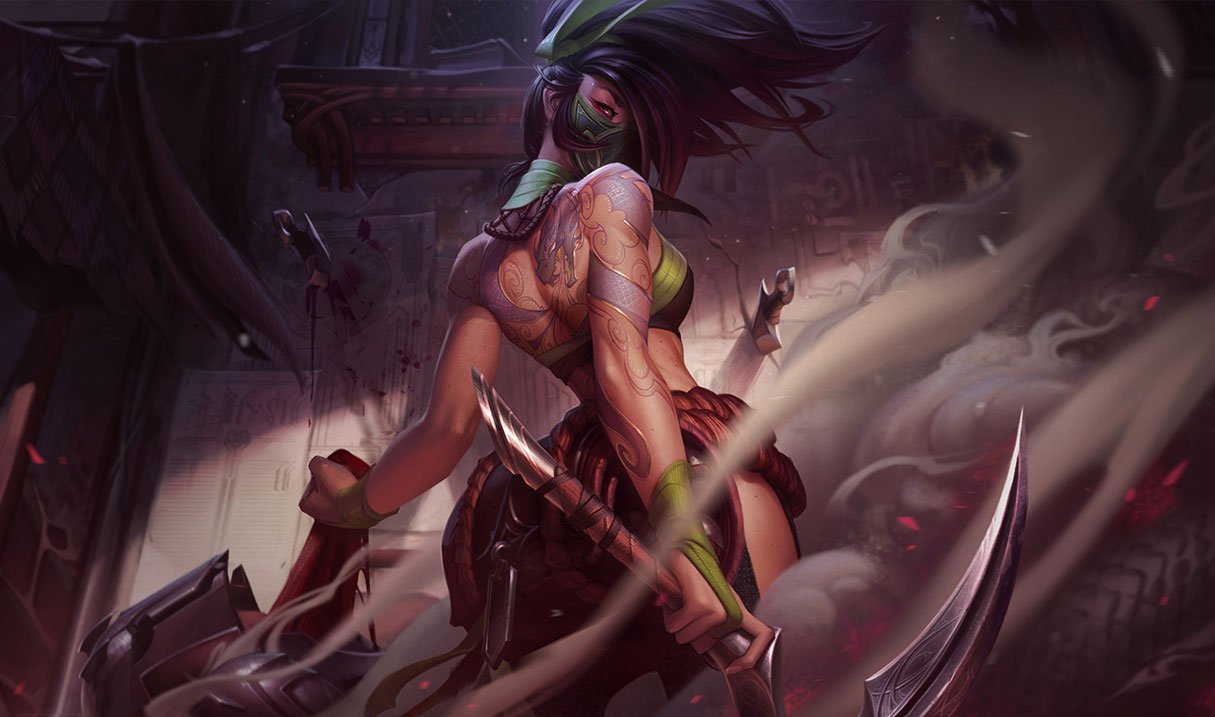
Akali original splash art. Copyright Riot Games
“Fear the assassin with no master” - Akali’s champion selection quote
The Kinkou Order is an ancient Ionian clan that preserves the region’s sacred balance. For more than one thousand years, the Order is led by a triumvirate of shadow warriors that tread both the mortal and spirit realms, with the roles being the following: the Heart of the Tempest, the Fist of Shadow, and the Eye of Twilight. Akali was once a Fist of Shadow under the tutelage of Shen, the incumbent Eye of Twilight, but left due to disagreements due to Shen’s inactivity during the Noxian invasion. Through Akali, we see how the concept of balance differs between Ionians. In the previous essay on Xayah and Rakan, we see how independent players interpret this sense of balance and justice, and this concept is continued here through the exploration of Akali’s character and her relations to the Kinkou Order.
The main tension that led to Akali leaving the Order was this: institutional justice must be indifferent by design as it cannot afford personal grievance, selective mercy, or emotional investment. The Kinkou Order operates in a way that for the sake of cosmic equilibrium, individual moral feelings have to be suppressed, and this constitutes their concept of “balance”. Restraint has never been Akali’s strongest forté, with her prodigious skills with the kama and kunai having to be restrained when facing opponents weaker than her.
However, this restlessness finally manifested to her departure from the Order when she had had enough of the Order’s pacifism and rigidity when people in Ionia were still suffering from the losses of the first Noxian invasion. In Taoism, this concept is known as wu wei, which can be translated as “non-action” or “effortless action”, and for Akali, this does not align with how she wants to live, at least, not anymore.
In this context, Akali’s positioning as an eventual “rogue vigilante” can be described as a failure of rational discipline that has existed for thousands of years, but this conflict will, one way or another, appear and (re)appear when human emotion is in play, and Akali’s youthful exuberance and idealism plays a significant role in her departure from the order. With this in mind, like with Xayah in the previous essay, Akali strives for balance and justice in her own way.
When Individual Conscience Exceeds Systemic Mandate

Akali during The Lesson. Copyright Riot Games.
“Can’t we just bend the rules? He’s just a kid!”. - Akali’s quote from the animation, Tales of Runeterra: Ionia - The Lesson.
The conflict that lies in the story of Akali and the Kinkou Order is that of their respective definitions of balance and justice. In the case of Akali, she is tired of the Order’s inaction regarding certain crucial issues (like the Noxian invasion) and enacts justice in her own way. This is a concept known as phronesis, or practical wisdom, where it is less about following fixed rules (in this case, the adherence to systemic equilibrium as per the laws of the Kinkou Order) and more about making morally sound judgments in situations of high complexity.
The question that occupied Akali’s mind before ultimately leaving the Order was this: “the Noxians invaded and killed our people in cold blood in their conquest for expansion. Why can’t we retaliate?” Phronesis dictates that actions must be done to either prevent, heal, or retaliate, but in the grand scheme of systemic equilibrium, it might not be the decision that ultimately satisfy the cosmic equilibrium that existed within Ionia, which was what the Kinkou Order has been doing for thousands of years: Watching the Stars (pure impartiality, held by the Eye of Twilight, currently held by Shen), Coursing the Sun (passage of judgment, the role of the Heart of the Tempest, held for thousands of years by the Yordle, Kennen), and Pruning the Tree (elimination of imbalance, the role of the Fist of Shadow, that was held by Akali and her mother Mayym). Ultimately, for Akali, mercy and compassion for Ionians who suffered from the consequences outweigh what the Kinkou Order defines as “balance”.
This puts Akali in a unique position where she wants to “deliver her own brand of balance” while operating outside of the limitations of the Order, positioning herself as a ronin. In Japanese culture, a ronin is a samurai without a master or lord, which was especially prevalent in feudal Japan (1185-1868), with the most famous example being Miyamoto Musashi, who went 62 duels without a defeat and is, to this day, considered to be one of the best swordsman in Japanese contemporary history. As a ronin, Akali’s job is to deliver justice in a way that traditional rules could not. In a way, she is against an order that has failed in its job of protecting the people, and particularly within East Asian theoretical frameworks, this gives her defection a culturally legible shape. By this, I mean Akali’s training as the Fist of Shadow (under the tutelage of Shen and her mother Mayym) remains intact even in this new role. The main difference is just that now, Akali operates independent of the order.
Despite this, Akali does not despise Shen and the other members of the Order. In fact, as depicted in the lore cinematic Tales of Runeterra: Ionia - “The Lesson”, Akali is still on friendly terms with Shen. There, their respective interpretations of balance and justice are displayed: Akali wanting to at least incapacitate the Noxian woodcutter, whereas Shen waits and lets nature (in this case, a spiritual golem-like creature) deliver its own brand of justice to the woodcutter.
Accountability without Structure
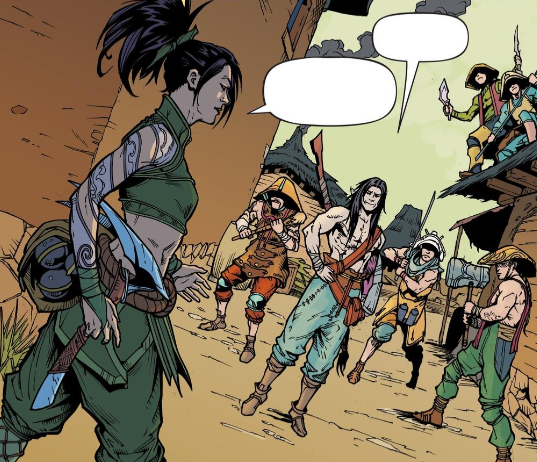
Akali confronting Shieda Kayn. Copyright Riot Games.
“Now living as an independent assassin, free from the restraints of the Kinkou's teachings, Akali lived as a vigilante, traversing the urban underground of Ionia and killing those that caused her people harm”. - description of Akali’s post-Kinkou life.
While the philosophical dilemma of whose definition of “balance” and “justice” is right can be debated, how their actions are accounted for is a different story altogether. While responsibility is defined as a collection of obligations associated with a certain role, accountability is the crediting (or blaming) of another person for an action that is normally associated with a recognized responsibility. As a philosophical concept, accountability requires an external body that is capable of judging another person’s actions.
Let’s take Akali’s situation in the aforementioned cinematic once again. When the woodcutter boy tried to steal wood from the sacred Ionian forest, he was promptly retaliated by the sacred golem waking up from its slumber, and Akali tried to defend the boy, citing that “he’s just a kid”. However, since the “cosmic equilibrium” of the forest was disturbed, both the boy and Akali were held accountable, even though he was the one who cut the wood. Ultimately, both she and the boy learned that balance and accountability are intertwined. By planting the seed into the sacred soil, the sacred golem deemed it a “fair trade” and went back to its slumber.
This behavior contrasts that of her master, Shen, who instead decided to watch from a distance and only helped Akali in dire straits, only intervening should their actions be accounted for beforehand. In this situation, Akali’s moral vigilantism is considered detrimental to that specific situation. Yes, she may be right and justified in her actions, but that does not mean her actions are inconsequential and at times, even if she operates mostly alone, she might need respite via external parties (like Shen) to save her from the consequences of her actions.
In this case, Akali’s pursuit for her own form of justice might also correlate with how structural injustice is a problem that no individual, no matter how powerful, can solve on their own. Yes, a woodcutter boy cutting down sacred wood can ultimately be accounted for, but say Akali decides to take down a polemic that has been structurally plaguing Ionia, like famine and poverty in the aftermath of the Noxian invasion. However sharp her kama and kunai are, she cannot cut through the root cause by herself, showcasing the limitations of individual vigilante on a greater scale.
Hence, she stays on friendly terms with the Order despite their disagreements; during the second Noxian invasion, as shown in the Awaken cinematic, she ended up assisting other Ionian champions in defending the land (alongside Kennen from the Kinkou Order, among others). At the end of the day, when a greater force comes to disturb (or destroy) the balance, differences are put aside to dismantle a common enemy.
As a character, Akali gives us a compelling case study on how individual and institutional justice intertwine with one another. Her complex relationship with Shen, Kennen, and the whole Kinkou Order is an essential part in Ionia’s worldbuilding and storytelling, both on an individual and holistic level. But ultimately, Akali's pursuit of justice would eventually converge with something far beyond the reach of any institution; an intelligence that transforms violence into composition and murder into meaning. Someone equipped with a collapsible rifle, a mask, golden aesthetics, and a fanatical obsession with the number four.
Further reading
Alasdair MacIntyre - After Virtue
Paul H. Robinson - The Moral Vigilante and Her Cousins in the Shadows
The concept of deontology by Immanuel Kant
The concept of wu wei in Taoist studies
Also watch: Tales of Runeterra: Ionia - “The Lesson” and “Awaken - 2019 Cinematic” by Riot Games