
Yunara: The Unbroken Faith and the World That Moved On
The Vow Beyond Witness
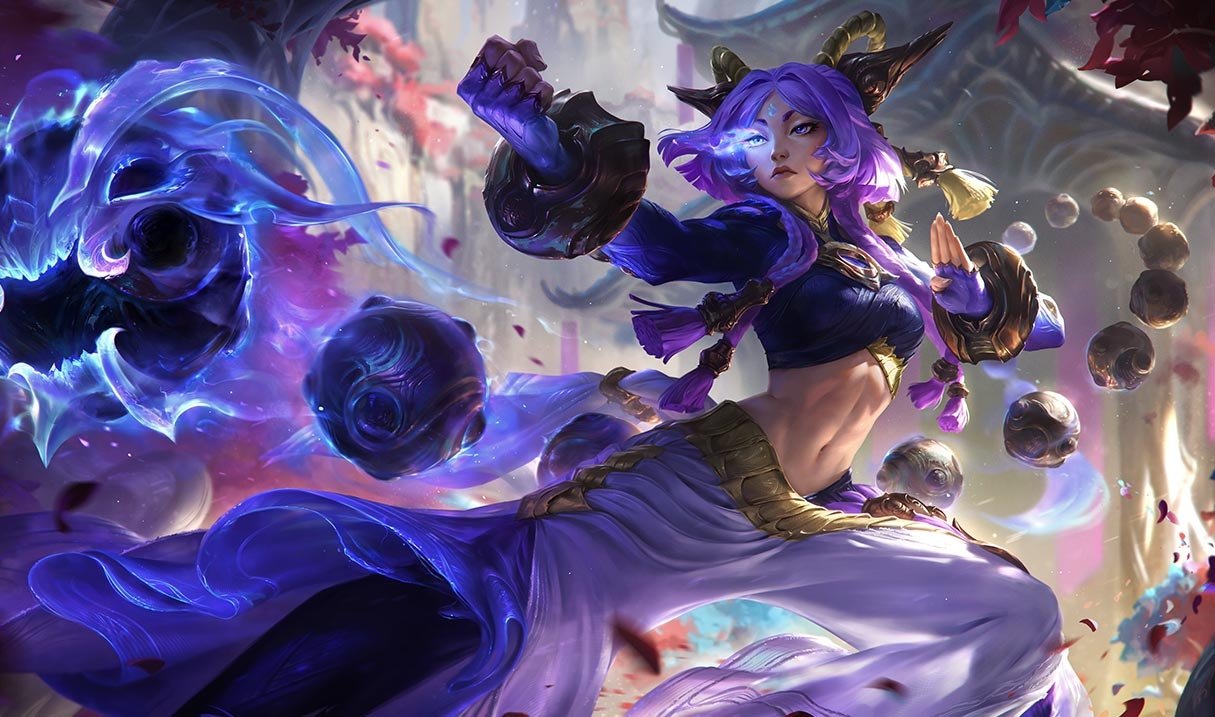
Classic Yunara splash art. Copyright Riot Games.
“I swore to guard the Temple of Twilight, and Bhinan’s parting words haunted me the most. “You go now into a place where few can follow. From here, it is you who must determine what is to be pruned. Deliver your judgments as if they were my own”. - Yunara’s monologue in her story, The Unbroken Faith
In the lore, Yunara’s story starts off with her being trained under the tutelage of the Kinkou, an ancient order that preserves the balance of Ionia and its relations to the Spirit Realm. Over the years, she would mature into a brave and competent warrior who wields the sacred relic called the Aion Er’na, which is a set of seven levitating orbs that unleashes the spiritual powers of its wielder. Also, her capabilities led to her being chosen as the Fist of Shadow in the Kinkou Order, a role that is tasked with eliminating those who threaten the balance of Ionia. Sometime after this, she would take part in the Great Darkin War, helping in the ‘banishment’ of Darkin such as Rhaast, Varus, and Xolaani. One of her allies during this war was Zaahen, a Darkin who did not succumb to the madness, but since he still had all the capabilities of the fallen Ascended, he sealed himself inside his glaive. Knowing that Zaahen needed to be tended to, Yunara swore to protect it (and him) inside the Spirit Realm.
In this case, she was already free of the institutional ‘shackles’ of the Kinkou. Gone are her responsibilities as the Fist of Shadow and the obligation to report to a master. She was, in a way, free. However, there is more to this task than meets the eye. Instead of serving an institution, she ended up serving Ionia itself, since guarding Zaahen meant keeping an eye on Ionia’s greatest possible threat, though he himself was an honorable being even after transforming into a Darkin.
Her thousand-year-long exile in the spirit realm can be interpreted as a Kantian deontological experiment, but at the same time, there are no other active agents working alongside her during her exile, so the question remains if the categorical imperative has an agency in a vacuum. Another lens we can use to interpret Yunara’s story is through the lens of Bernard Williams’ ground project. In this case, the vow to protect Zaahen in the spirit realm is her so-called ground project, and after he was freed from his own glaive by Xin Zhao’s sacrifice, that project is finished, so the question becomes the following: “What’s next for Yunara?”
After the events of the Requiem motion comic (that depicts the funeral ceremony of Xin Zhao in Demacia), Yunara is depicted returning to Ionia, which might mean the resumption of her role as the Fist of Shadow (that was recently held by Akali before she departed the Kinkou) or hunting the rest of the Darkin alongside Zaahen.
The Epistemology of the Returned
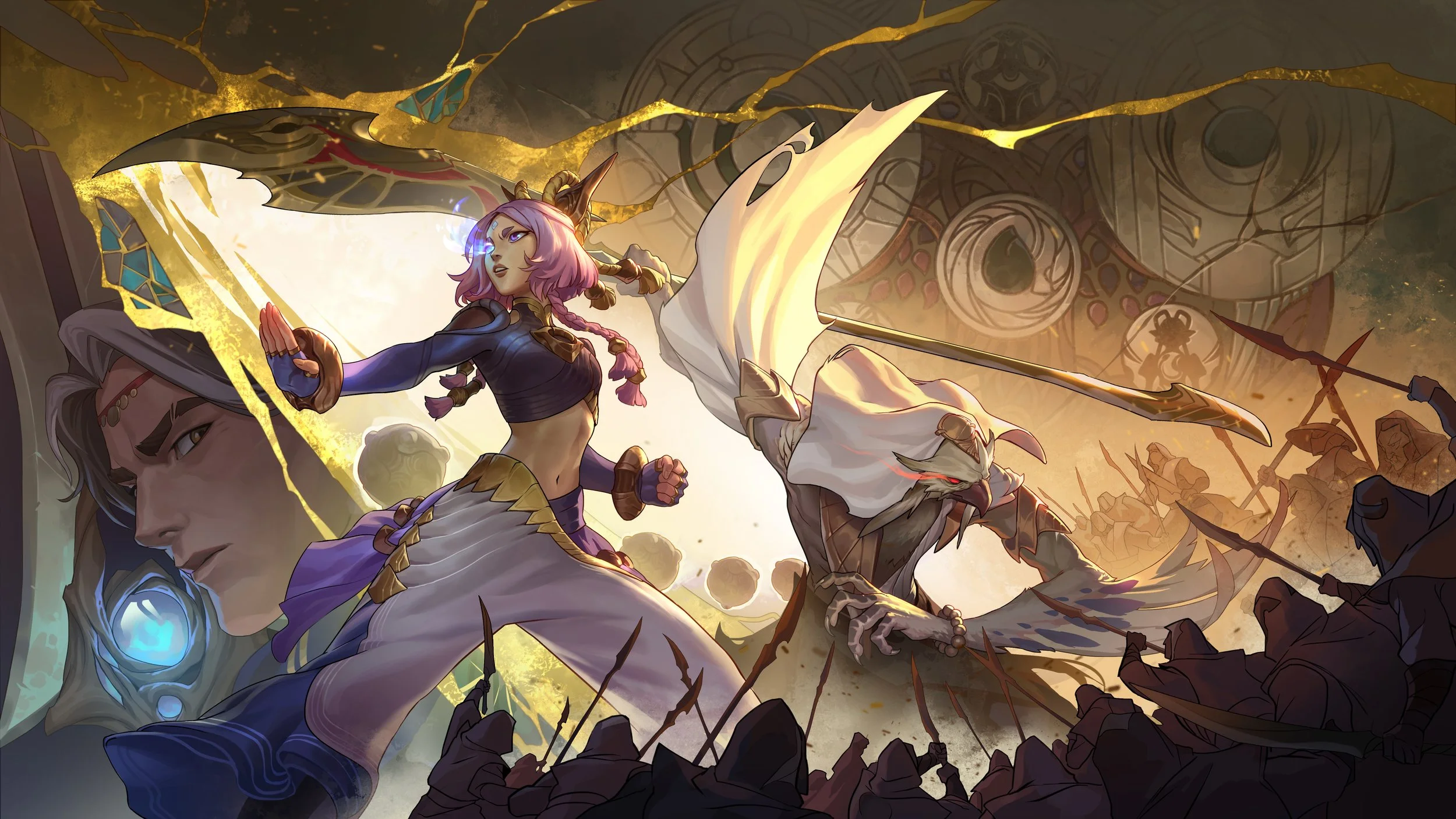
Yunara alongside Zaahen in The Truth. Copyright Riot Games.
"I once vowed to preserve balance. To prune the tree. To strike from the shadows—and deliver judgment". - one of Yunara’s first move quotes.
Yunara returned to an Ionia that was completely different from what she knew in the past. For one, Ionia was invaded by Noxus, which created generational trauma for its people and its nature. Ancient willows are dying and people are afraid to fight back. However, the biggest change came while returning to the Kinkou Order. While her former master, Kennen, is still holding the position as the Heart of the Tempest, the new Eye of Twilight, Shen, practices a more conservative and passive approach to handling the conflicts, which led to the departure of his own acolyte, Akali, and the ongoing conflict with former sworn brother and leader of the Order of the Shadows, Zed. This Ionia one thousand years in the future is not the Ionia Yunara knew, and in a sense, no longer her ‘home’.
Yunara’s existence can be explored through the phenomenology of time-consciousness. She was born in Ionia more than one thousand years before the current timeline and after a thousand-year-long stint inside the spirit realm, she returned to an Ionia that has gone through dramatic changes during that time period. We have seen this phenomenon in other forms of media, such as Captain America (who was frozen in ice for seventy years) and Avatar Aang from Avatar: The Last Airbender (who had the same scenario but for one hundred years). For Yunara, returning to the material world does not mean returning home. In fact, the home she knows is gone, and what exists in front of her is a world that is completely different.
Another perspective we can take to contextualize Yunara’s story is through the lens of interculturalism and diasporic identity. Imagine this: you leave your homeland at ten years old and move to a completely different culture. Let’s take an Indonesian man as an example, and he moved to the Netherlands at age ten before finally returning to Indonesia at age fifty. While not as temporally drastic as Yunara, the Indonesian man, while being Indonesian, does not relate to the lived experiences of Indonesians in general, since he spent the majority of his life in the Netherlands. In the forty years he was away, Indonesia changed dramatically, and the Indonesia he grew up in all those years ago does not exist anymore. Yunara experienced this exact phenomenon, but cranked to maximum, since she ‘missed out’ on one thousand years’ worth of change and development. Stuart Hall explains this exact phenomenon, but he took the example of a Jamaican immigrant living in England instead.
Finally, Yunara exists as someone inhabiting what Homi Bhabha defined as the ‘third space’, a realm where cultures intersect. However, in her case, this ‘third space’ is the intersection between the Ionia Yunara knew in the past and the Ionia of today. This makes her story compelling as the region has transformed, yet her development and relation to the region ‘paused’ during her thousand-year-stay inside the spirit realm. However, one thing in her story is clear: her fervor is unbound and regardless of what version of Ionia she finds herself in, she will fight for it, no matter what.
Faith Unbroken in a New World
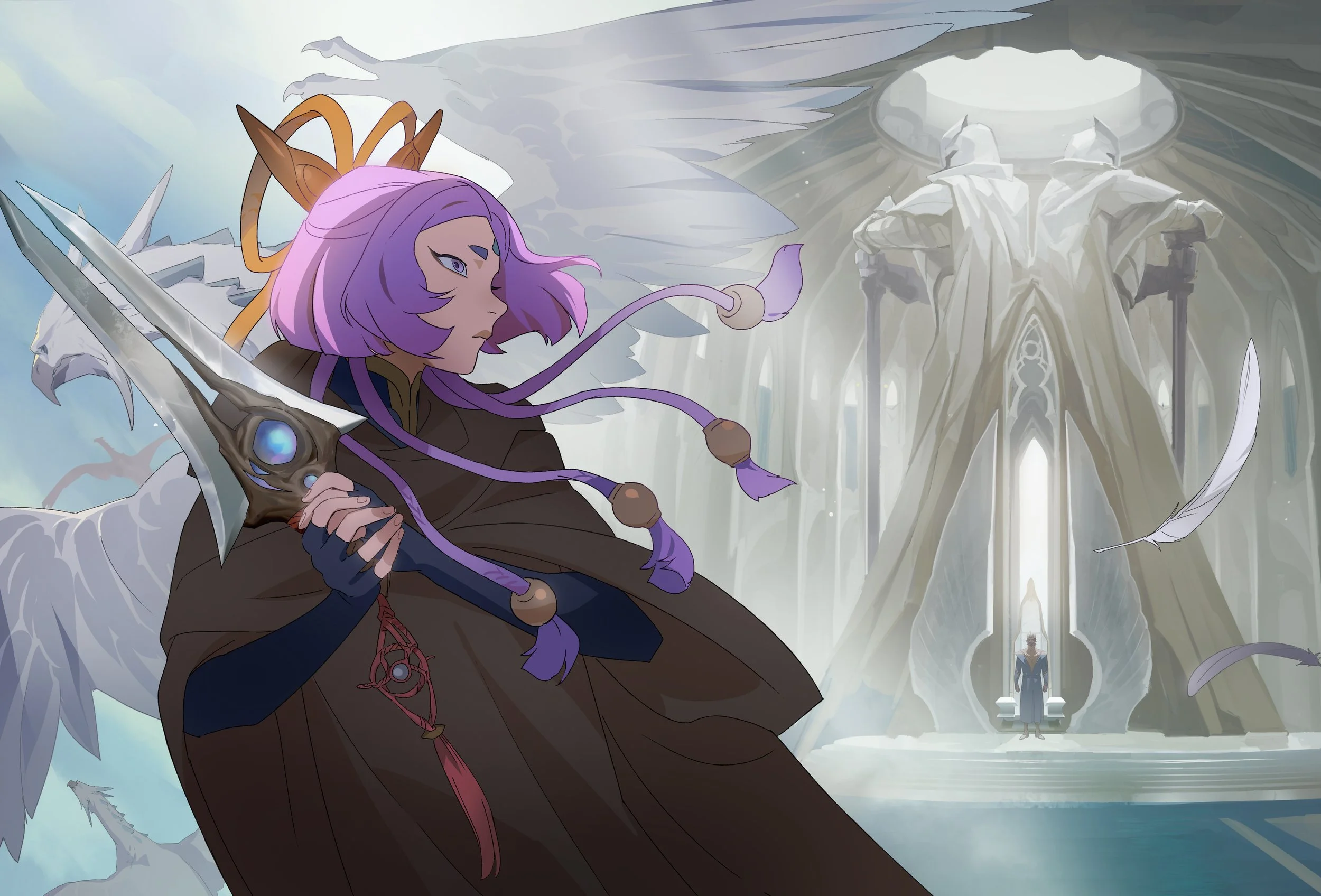
Yunara returning Xin Zhao’s spearhead to Demacia in Spearhead. Copyright Riot Games.
"Myth is to culture, as conflict is to life. They reveal what people have deemed most important". - one of Yunara’s long move quotes.
And so, despite everything she knew about Ionia changed in her thousand-year exile, Yunara’s vow remained the same: protecting Ionia. However, the context in which she upholds this vow is different compared to her previous life. In the lore, she returned Xin Zhao’s spear to Demacia, despite barely knowing him and the region he called home, spending months there to understand more about his beloved kingdom and why he was so beloved by everyone, especially those who are part of or related to the Demacian royal family (i.e., Jarvan IV, Garen, Lux, and Sona). By contextualizing the relationship between Xin Zhao and Demacia, she experiences a different perspective in protecting Ionia in the future, as she can now count Demacia as a future ally to Ionia in the future, should the events of the Great Darkin War happen again.
Here, we can also contextualize the events of her return as a form of oikeiosis, which essentially means the familiarization of oneself. While Yunara’s vow remains unbroken, her recent lived experiences add a layer of self-realization that was probably absent in the past. Now, since she is no longer part of the Kinkou she knew previously (but apparently still has ties to the current one), she is free to forge her own path not only as a warrior, but also as an Ionian. The narratives explored within Ionian champions provide many different perspectives in how to bring the region forward, from radical eye-for-an-eye politics by the likes of Zed to pacifist methods posited by Shen and the present version of the Kinkou Order. Through exploration and self-identification, Yunara may find her own method of protecting Ionia that actively utilizes the Aion Er’na (i.e., through combat and physical confrontation).
The future of Yunara’s narrative is going to be quite intriguing. With Zaahen finally free, she does not have to keep her eye on him all the time, and is free to literally do whatever she wants. The Requiem comic showcased her adventures in Demacia quite well and it might be interesting to explore that part of her story even further. However, in an Ionian context, I personally am intrigued to see how she interacts with characters unrelated to the Kinkou, especially those with long lives, such as Ahri or Lillia. Also, a character-related conflict that might come up is likely with Irelia. Yunara’s absence during the Noxian invasion might ruffle the feathers of someone who fought so hard to defend the region, and in a way, by sacrificing herself to the spirit realm to look over Zaahen, she ‘failed’ to protect Ionia during its time of need. But then again, her story has been embedded into the annals of Ionian history as the ‘devoted shrine maiden’ who sacrificed herself to stop the demons (Darkin) from destroying Ionia.
While not the main topic of this essay, Yunara touched upon diasporic existence and unfamiliarity in a completely different world. For Ionians, there are so many who fit this bill, such as Xin Zhao and Sona who are also Demacian and Caitlyn who, according to Arcane lore, has Ionian ancestry from her father while being born in Piltover. However, the one we explore next has his identity revolve around hybridity, being the poster child for the relationship between humans and the vastaya.
Further reading
Edmund Husserl - The Phenomenology of Internal Time-Consciousness
Stuart Hall - Cultural Identity and Diaspora
The concept of oikeiosis in stoicism
The entirety of narrative lore in the Ionia season in League of Legends (2025)
Reading Runeterra was created under Riot Games' "Legal Jibber Jabber" policy using assets owned by Riot Games. Riot Games does not endorse or sponsor this project.